
How to Choose a Binding Machine: Plastic Comb, Metal Wire, Coil and Thermal Binding
Binding machine buying guide: plastic comb, metal wire, coil and thermal binding compared, punching capacity, and model advice for notebooks and books.
A spiral binding machine punches sheets along one edge and joins them with a plastic comb, metal wire or a plastic coil (spiral); it is used to make reports, presentations, notebooks and booklets. Thermal and glue binding machines, on the other hand, create a book-style binding without punching, using the glue in the spine of the cover. To choose the right machine, weigh the binding type, the number of sheets punched at once and your daily workload together. All models are on our binding machine models page.
Last updated: 24 November 2026
Short answer: Choose plastic comb binding for office reports and presentations, metal wire for a corporate, elegant look, coil (spiral) binding for notebooks and catalogues whose pages turn 360 degrees, and thermal or glue binding for a book look. For occasional use a manual model is enough; if many documents are bound every day, a model with electric punching saves time.
What Is a Binding Machine Used For?
A binding machine turns loose sheets into a tidy, durable document. Offices use it for reports, proposals and presentation files; schools for projects and homework; stationery shops and copy centres for theses, catalogues and notebooks. A bound document prevents lost pages, opens flat and looks professional.
Binding Types: Plastic Comb, Metal Wire, Coil and Thermal
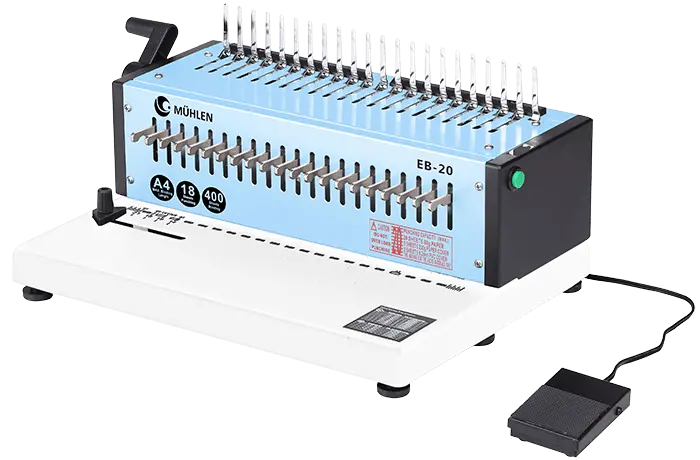
- Plastic comb: rectangular holes are punched along the paper edge and a plastic comb is inserted. It is economical, and the comb can be opened to add pages. Mühlen's SD 12, P20A, SD-22B and the electric EB-20 belong to this group.
- Metal wire: holes are punched closer together and a metal wire is closed to bind the pages. It gives a more elegant, corporate look and is preferred for diaries, calendars and presentation files. Models: TD-12, M20A, TD-25.
- Coil (spiral, ring): a spring-shaped plastic coil is threaded through round holes. Pages turn 360 degrees; ideal for notebooks, catalogues and manuals. Models: PD 15, H20A, PD20. The ends of the coil are crimped with the Pens 5 pliers.
- Thermal and glue (hotmelt): no punching. In thermal binding a cover with a glued spine (Deckel thermal binding covers) is heated and bonds to the sheets; glue (hotmelt) machines produce a print-shop style book binding. Models: RD-600XH, TCM 77, TCM 97, TCM 111.
Punching Capacity Is Not the Same as Binding Capacity
Product information lists two different values: punching capacity shows how many sheets the machine can punch at once, while binding capacity shows how thick a document it can bind in total. For example, the SD 12 punches 12 sheets at once and binds documents up to 200 sheets; a 200-sheet document is punched in batches of 12 sheets. If your daily workload is high, models with a large punching capacity (20–25 sheets) save a lot of time.
Manual or Electric?
On manual models punching is done with a lever; they are economical and sufficient for offices that bind occasionally. On electric models a motor does the punching, so you can work in series without tiring; they suit offices, schools and stationery shops that bind many documents a day. The EB-20 punches 20–25 sheets with an electric motor; among coil models the PD 15, H20A and PD20 are electric. Among glue models the TCM 97 and TCM 111 are fully automatic.
What Does a Disengageable Pin System Do?
A disengageable (adjustable) pin system lets you switch off some of the punching dies. This way no half holes are left at the edge of A5 or non-standard documents and the holes are punched where you want them. The SD-22B and P20A have 21, the M20A 34, the H20A 46 and the PD20 53 disengageable pins.
Which Machine for Making Notebooks and Binding Books?
- Notebooks and diaries: coil binding, which lets pages open fully (PD 15, PD20), or elegant metal wire (M20A, TD-25).
- Books, theses and catalogues: for a book-spine look the thermal RD-600XH or the glue TCM 77; for high volumes the fully automatic TCM 97 or the TCM 111 with a capacity of 200 books per hour.
- Reports and presentation files: plastic comb (SD 12, SD-22B, EB-20).
Mühlen Binding Machine Comparison Table
Values are compiled from the technical information on our product pages.
| Model | Binding type | Operation | Punches at once | Key feature |
|---|---|---|---|---|
| SD 12 | Plastic comb | Manual | 12 sheets | 21 holes; binds up to 200 sheets; most economical model |
| P20A | Plastic comb | Manual | 20 sheets | 21 disengageable pins; double-hinged handle |
| SD-22B | Plastic comb | Manual | 22 sheets | 21 disengageable pins; heavy use |
| EB-20 | Plastic comb | Electric punching | 20–25 sheets | Binds up to 400 sheets |
| TD-12 | Metal wire | Manual | 12 sheets | 34 holes; economical wire binding |
| M20A | Metal wire | Manual | 20 sheets | 34 disengageable pins; double hinge |
| TD-25 | Metal wire | Manual | 25 sheets | F4 (210×330 mm) documents; binds 200 sheets |
| PD 15 | Coil (spiral) | Electric | 15 sheets | Electronic coil inserter |
| H20A | Coil (spiral) | Electric | 20 sheets | 46 disengageable pins |
| PD20 | Coil (spiral) | Electric | 20 sheets | 53 disengageable pins; heavy use |
| RD-600XH | Thermal | Electric | No punching | Up to 480 pages; with thermal cover |
| TCM 77 | Glue (hotmelt) | Electric | No punching | Soft and hard covers; desktop |
| TCM 97 | Glue (hotmelt) | Fully automatic | No punching | 320 mm binding length |
| TCM 111 | Glue (hotmelt) | Fully automatic | No punching | 200 books per hour; touchscreen |
Model Recommendations by Use
- Small office, occasional binding: SD 12 (plastic comb) or TD-12 (metal wire).
- Regular office use: P20A, SD-22B or M20A; the double-hinged handle punches more sheets with less force.
- Busy office, school and stationery shop: the electric EB-20 (plastic comb) or PD20 (coil); for larger documents up to F4, the TD-25.
- Book and catalogue production: TCM 97 and TCM 111.
Complementary Products: Corner Cutting and Consumables
Rounding the corners of a bound document improves its look and prevents curling. The K100 is a corner rounder with a 4 mm radius; the L30 cuts corners of up to 300 sheets with a 6 mm blade and punches 5 mm holes; the electric L777 rounds the corners of 500 sheets at once. For thermal binding, A4 Deckel thermal binding covers are used, and the Pens 5 to crimp coil ends.
Frequently Asked Questions
What is the difference between comb binding and coil binding machines?
In plastic comb binding a comb-shaped spine is inserted into rectangular holes, and the comb can be opened to add pages. In coil binding a spring-shaped plastic coil is threaded through round holes; pages turn 360 degrees, which is better for notebooks and catalogues.
How many sheets does a binding machine punch?
Depending on the model, between 12 and 25 sheets at once: the SD 12 and TD-12 punch 12 sheets, the PD 15 15 sheets, the P20A, M20A, H20A and PD20 20 sheets, the SD-22B 22 sheets, the EB-20 20–25 sheets and the TD-25 25 sheets.
Which binding machine is used to make notebooks?
Because pages should open fully, coil or metal wire binding is usually preferred. Mühlen's PD 15, H20A and PD20 are coil models; the TD-12, M20A and TD-25 are metal wire models.
How does thermal binding work?
The sheets are placed inside a thermal cover with a glued spine and heated in the machine; the glue melts and bonds the sheets to the cover. No punching is needed and the result looks like a book. The RD-600XH thermally binds up to 480 pages.
Is an electric binding machine worth it?
Yes, if many documents are bound every day: motorised punching needs no arm strength and speeds up serial work. For occasional binding, manual models are sufficient and more economical.
Why is a disengageable pin system important?
It prevents half holes at the edge of non-standard documents and lets you punch holes exactly where you want them.
Who prepared this: The Mühlen expert team at Karadeniz Dış Ticaret, the Mühlen distributor in Türkiye. How it was prepared: Model values were taken from the technical specifications on the product pages; values not found in the product data were not written or were left as "not specified". The text was written with AI assistance. Why: So you can compare the options that fit your needs before choosing a model.
Related Content
For model and price comparisons see our article on binding machine prices, and for all models our binding machines category. To protect bound documents see our laminating machines, and to cut sheets to size our guillotine and paper cutters or the paper cutter buying guide.
To find the right model and request a quote, use the form on the product pages or contact us.