
How to Choose a Money Safe: 6 Criteria for Businesses and Homes
Choosing a money safe comes down to deposit slot, size, body and door thickness, opening method, alarm and anchoring, compared with real Mühlen model values.
Short answer: When choosing a money safe, first look at how the cash gets in (through the door, through a deposit slot, or via a drawer), then at size, body and door thickness, the opening method, alarm behaviour and whether it can be anchored. These six criteria explain almost all of the difference between Mühlen models in the same category. Below we compare each criterion using the real values stated on the product pages.
1. How Does the Cash Get In? Lid, Deposit Slot or Drawer
In a business, a money safe is often opened and closed with every transaction, so the first question is not "how many litres?" but how it will be used day to day.
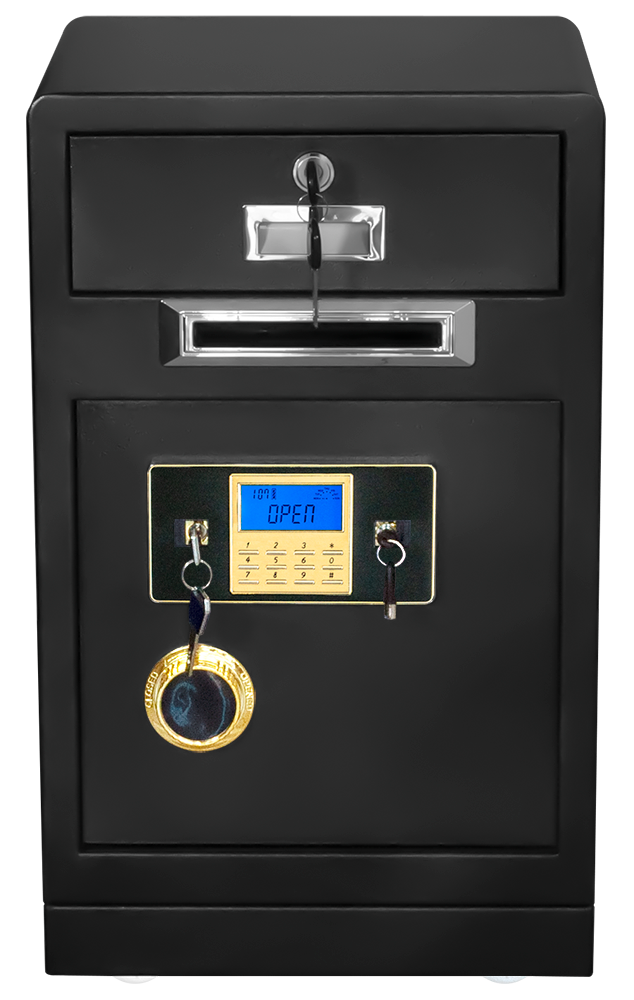
- Deposit (drop) safes: These let you drop cash and documents through a slot on top without opening the safe door. On the Mühlen CS70 and CS60, this slot measures 18×2 cm. The product pages describe this design for places with heavy cash flow such as petrol stations, supermarkets and charities: the cashier can drop the day's takings in without opening the safe.
- With drawer: The CS70 has a built-in steel drawer that is locked and unlocked with a key (interior 33×30×9 cm). Important documents and cash can also be placed in this drawer without opening the safe. The Oben KS333 is a drawer-type safe with a code lock.
- Top-opening lid: The Oben KS222 opens from the top; according to the product page, the lid opens on a damper.
- Classic front-opening model: The Schutz series (17, 25, 45, 50, 60, 80) are safes with a front-opening door; the shelf and compartment layout is geared more towards end-of-day cash and document storage.
2. Size: Interior Dimensions Matter, Not Litres
Volume on its own can be misleading; the real question is "what will fit inside?" (a cash bag, a document folder, a laptop). The values below are taken from the product pages:
| Model | Dimensions / volume | Construction |
|---|---|---|
| Schutz 17B | 23×17×17 cm, 7 litres | Small, keypad |
| Schutz 25-LB | 35×25×25 cm, 22 litres (two levels) | Large LCD screen |
| Schutz H43-TA | 43×36×21 cm, 33 litres | Wall- or floor-mountable |
| Schutz 45T | 45×41×35.5 cm | One-piece body, fits a laptop |
| Schutz 50T | 50 cm high, 41 cm wide, 36 cm deep | Medium size |
| Schutz 60-T | 600×410×355 mm | 3 compartments + key-locked compartment |
| Schutz 80-T | 116 litres | 3 removable shelves + locked compartment |
| CS70 | 70×42×38 cm | Deposit slot + drawer |
When deciding on size, it makes sense to think one step up from "today's needs": a safe cannot be enlarged later, and cash and documents build up over time.
3. Body and Door Thickness, Locking Bolts
Steel thickness is one of the indicators of how well a safe resists forced entry, but it is not enough on its own: the number and thickness of the locking bolts that secure the door to the body also matter. The values on the product pages:
| Model | Body | Door | Locking bolts |
|---|---|---|---|
| Schutz 17B | 1 mm | 3 mm | Not specified |
| Schutz H43-TA | 3 mm | 5 mm | Not specified |
| Oben KS222 / KS333 | 3 mm | 5 mm | 2 bolts, 20 mm |
| Schutz 50T | 3–4 mm | 7 mm | 2+3+2 locking cylinders |
| Schutz 60-T | 3 mm | 10 mm | 7 bolts, 2+2 keys |
| CS60 | 3 mm | 10 mm | 5 bolts, 30 mm |
An honest note is due here: a small safe with a 1 mm body is designed for storing everyday cash and documents; for the end-of-day takings of a high-turnover business, models with a 3 mm body and a 5–10 mm door are the right range.
4. Opening Method: Code, Key, or Both
- Code or key: The Schutz H43-TA opens with either a digital code or one of the 2 spare keys supplied with the safe.
- Code + key (dual security): On the Schutz 60-T and 80-T, you can set the safe to require the code and key together, or to open with the code alone. This setup is useful if several people use the safe and you want to keep a record.
- Administrator and user/guest code: On the Schutz H43-TA and 25-LB, separate administrator and user codes can be set.
- Motorised lock: The KS222, KS333 and Schutz H43-HQ use a motor to retract the locking cylinders once the correct code is entered; on the H43-HQ, the door opens and closes automatically when you enter the code and press "#".
For a detailed comparison of lock types, see our comparison of fingerprint, keypad and key safes.
5. Alarm and Wrong-Code Behaviour
What the safe does when a wrong code is entered is the first line of defence against a break-in attempt:
- KS222 and KS333: after 4 consecutive wrong codes, the display/panel locks for 5 minutes.
- Schutz 25-LB: after 3 consecutive wrong codes, the keypad locks and the alarm sounds.
- Schutz 50T and 60-T: the alarm sounds after 3 wrong codes or when shaking is detected.
- Schutz 45T: the alarm is triggered by consecutive wrong entries or by impact/shaking, and the panel locks temporarily.
6. Anchoring: A Safe You Can Carry Away Is Not Secure
A lightweight safe can be carried off even if it cannot be opened, so being able to anchor it to the floor or wall is an important criterion. The KS222 has 4 screw slots for fixing it to the floor (lying flat) or the wall (upright), and the Schutz H43-TA comes with 4 dedicated mounting screws. For more permanent solutions such as in-wall installation, see our guide to choosing an in-wall steel safe.
Which Type for Which Business?
- Petrol stations, supermarkets, donation boxes, places where cash is dropped in often: The CS60 or CS70 deposit safe.
- Small shops, kiosks, end-of-day documents and cash: Schutz 25-LB, H43-TA or 45T.
- Offices and places with several users: The Schutz 60-T / 80-T, with administrator + user codes and a code + key option.
- Hotel rooms: The H43-HQ or 25-LB, which allow a guest code to be set.
- Home: The small Schutz 17B/17W; for details see our guide to choosing a steel safe for the home.
If you also deal with cash counting, take a look at our money counting machines, which speed up the daily count alongside the safe.
Frequently Asked Questions
What is a money safe?
A money safe is a safe, usually with a steel body and a lock system, used to protect cash, documents and valuables against theft. Mühlen money safes include models with a code lock, a key lock, or both.
What does a deposit safe mean?
It is a design that lets you drop cash and documents through a narrow slot on top without opening the safe door. On the CS60 and CS70, this slot measures 18×2 cm.
Should I buy a safe with a code or a key?
Either is suitable for a single-user safe at home. In businesses where several people use the safe, models that allow administrator and user codes and offer a code + key option are more flexible in terms of record-keeping and authorisation.
Are these money safes fire-resistant?
No fire-resistance value is stated on the product pages of the Schutz, Oben and CS series safes covered in this article. If paper documents also need protection from fire, see our guide to how long a fire-resistant safe lasts and the fire-resistant steel safe category.
Can the safe be anchored to the floor or wall?
On some models, yes. The KS222 has 4 screw slots and the H43-TA comes with 4 mounting screws. Whether a model can be anchored is stated on its product page.
Related Content
- Steel Safe Guide: Types, Security Indicators and Selection Criteria
- Business Safes by Sector: Hotels, Jewellers, Shops and Petrol Stations
- Steel Safes · Installed Steel Safes
- Cash Drawer Models · Cash Register Drawers
To find the right money safe for your business, use the form on the product pages or get in touch with us.