
How to Choose a Home Safe: Size, Fire Risk and Lock Guide
Choosing a steel home safe starts with what you store, then fire and water risk, anchoring and lock type. A guide for passports, jewellery, documents and laptops.
Short answer: When choosing a steel safe for your home, answer these questions in order: what will you store (cash, passport, jewellery, documents, laptop), is there a fire or water risk, where will the safe go and can it be anchored, and who will open it. A small safe is enough for a passport, jewellery and cash; documents and a laptop call for a medium size, and firearms need a separate gun safe. Fire resistance is a separate feature and not every home safe has it.
1. Start by Listing What You Will Store
What determines the size of the safe is not its volume but the dimensions of the items you want to keep in it:
- Passport, ID card, a few pieces of jewellery, cash: A small safe is enough. The Schutz 17B measures 23×17×17 cm and holds 7 litres; it suits a passport and a small stack of cash.
- Jewellery, cash and a few documents: The Schutz 25-LB is 35×25×25 cm, 22 litres and has two levels; the H43-TA is 43×36×21 cm, 33 litres.
- Title deeds, contracts, an A4 folder, a laptop: The Schutz 45T (45×41×35.5 cm) is described for laptops and valuables. For more items, there is the 50 cm high Schutz 50T or the 600×410×355 mm Schutz 60-T.
The rule for sizing is simple: buy one size larger than you think you need. A safe cannot be enlarged later, and household valuables and documents accumulate over time.
2. Fire and Water Risk: Not Every Home Safe Is Fire-Resistant
A steel body protects against theft; protection against fire is a separate feature. No fire-resistance value is stated on the product pages of the Schutz series above. If you plan to store documents that are hard to replace, such as title deeds, passport copies and contracts, you should look for a fire-resistant model.
Mühlen's fire-resistant models come in 30, 60 and 120-minute classes (843, 927 and 1010 °C), and the interior temperature is kept below 177 °C for paper, or below 80 °C on some models. We explain what these values mean in our guide to how long a fire-resistant safe lasts; you can find the models in the fire-resistant steel safe and fire- and water-resistant safes categories. For portable and bag-type solutions, see the bag safes category.
3. Where Will the Safe Go?
The location of the safe is part of its security:
- Anchoring to the floor or wall: A lightweight safe can be carried off even if it cannot be opened. The H43-TA has 4 mounting screws and the Oben KS222 has 4 screw slots; you can fix the safe to the floor (lying flat) or to the wall (upright).
- In-wall: The Wall 27-LB is designed to be installed inside a wall (15 litres, 24×35×17 cm). For details, see our guide to choosing an in-wall steel safe.
- Hidden placement: If you want to conceal the existence of the safe, there are book-style hidden safes. The Mühlen Secret Safe series are code-operated safes disguised as a dictionary and a travel guide; we explain how they work and their limits in our article on hidden steel safe models.
A practical rule: not everyone in the house needs to know where the safe is; if the safe is in a visible place, anchor it to the wall or floor.
4. Who Will Open It: Choosing the Lock
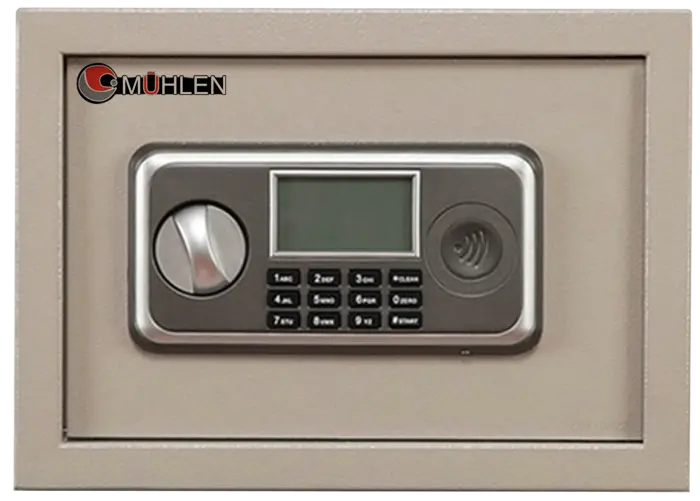
- One person, occasional use: A code or a key is enough (the H43-TA offers both a digital code and 2 spare keys).
- Several people in the family: Fingerprint models (for example the Schutz 60P) do not require anyone to remember a code.
- Administrator + user separation: On the Schutz 25-LB and H43-TA, separate administrator and user codes can be set.
We cover the pros and cons of each lock type in our comparison of fingerprint, keypad and key safes.
5. Five Common Mistakes When Choosing a Home Safe
- Buying a safe that is too small. It fills up within the first year, and you end up needing a second one.
- Ignoring fire risk. If you store documents, look for a model with a stated fire rating.
- Not anchoring it. A lightweight safe can be carried away.
- Keeping the emergency key inside the safe. If you forget the code, you will not be able to open it; keep the key somewhere secure, away from the safe.
- Forgetting about the battery. The battery status of electronic safes is shown on a screen or LED (for example on the 17B and 50T); do not ignore the warning.
Frequently Asked Questions
What is the right size of steel safe for a home?
It depends on what you store. For a passport, jewellery and cash, small and medium models of 7–33 litres are suitable; for documents, folders and a laptop, models 45 cm or more in height are suitable.
Is a small steel safe secure?
A small safe is designed for storing everyday cash and documents. Body and door thickness varies by model (for example 17B: 1 mm body, 3 mm door; H43-TA: 3 mm body, 5 mm door). What matters is anchoring the safe to the floor or wall.
Should I choose a hidden safe or a steel safe for the home?
A hidden safe is for concealing the existence of the safe and suits small amounts of cash and jewellery. If you need to store documents or high-value items, or want resistance to forced entry, a steel-bodied safe that can be anchored is more suitable.
Is a home safe fire-resistant?
Not every model. Fire resistance is a separate feature; fire-resistant models are stated on the product page in the 30, 60 or 120-minute class.
Can a safe be built into a wall?
Yes, there are recessed (in-wall) models designed to be installed inside a wall (for example the Wall 27-LB). Make sure the wall structure is suitable before installation.
Related Content
- Steel Safe Guide: Types, Security Indicators and Selection Criteria
- How to Choose a Money Safe: 6 Criteria for Businesses and Homes
- How to Choose a Gun Safe: 7 Criteria for Rifles and Handguns
- Steel Safes · Installed Steel Safes · Gun Safes
To find the right safe for your home, use the form on the product pages or get in touch with us.