
How to Choose an In-Wall Safe: Wall Type, Depth and Opening Method
Choosing an in-wall (recessed) steel safe means checking wall construction, depth, door swing and opening method, and weighing it against an anchored safe.
Short answer: An in-wall (recessed) steel safe is a solution in which the body of the safe sits inside the wall and only the door and panel are left exposed. It becomes very hard to remove and carry away, and the safe stays out of sight. When choosing, consider the interior volume, the depth and construction of the wall, the direction the door opens, the opening method, and the fact that the installation cannot be undone later. If you do not want to build it into a wall, a safe screwed to the floor or wall is a more flexible alternative.
What Is a Recessed Safe, and When Does It Make Sense?
A recessed safe is installed inside the wall; only the front face is visible from outside. This has two clear advantages: the safe cannot be carried off (it becomes part of the wall) and it has low visibility (it can be hidden behind a painting, cupboard or door). The drawback is that its position is permanent: moving the safe to another room later means opening up the wall again.
A recessed safe makes sense in these cases:
- When the safe will be used in a permanent, fixed place (home office, bedroom, back room of a business).
- When you want to go a step beyond anchoring to prevent it being carried away.
- When discretion matters because nothing protrudes from the surface.
In-Wall Safe Options at Mühlen
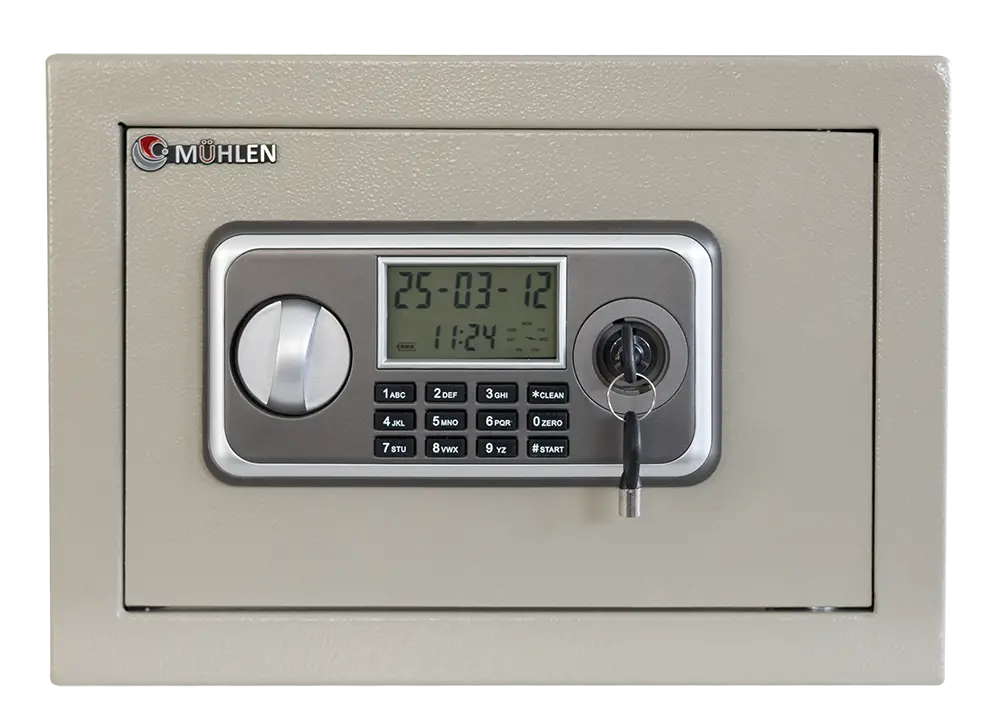
The Mühlen Wall 27-LB is a steel safe designed to be built into a wall. The values on the product page:
- Interior volume: 15 litres, 24×35×17 cm.
- Body and door: 5–10 mm thick steel.
- Opening: Code or key; separate codes for user and administrator, plus an emergency key.
- Shelf: A removable shelf, so the interior can be used divided or as a single space.
- Door: Internal hinges.
- Panel: Backlit LCD screen, date and time display.
If fire resistance is also needed, the MP 53K is a recessed-type, high-heat-resistant model with a fingerprint lock; the product page states that 30 different fingerprints can be registered. To understand what fire classes mean, see our article on how long a fire-resistant safe lasts.
Five Checks Before Building It In
- Wall construction. Solid walls such as concrete and brick are suitable for a recessed safe. In non-load-bearing lightweight partition walls (such as plasterboard), the safe may not be attached to a load-bearing base; clarify the wall construction in advance with the tradesperson doing the installation. Before opening a niche in a load-bearing wall, consult the person responsible for the structure.
- Wall depth. If the depth of the safe (check the dimensions on the product page; Wall 27-LB is 24×35×17 cm) is greater than the thickness of the wall, the safe will either protrude or cannot be recessed. Check the measurement along the full wall.
- Electrics and plumbing. Make sure there are no cables, pipes or water lines where the niche will be cut.
- Door clearance. Enough free space must remain in front for an internally hinged door.
- Is the safe's position permanent? A recessed safe cannot be moved later. If you rent your home or are thinking of moving, an anchored safe is more suitable.
Recessed Safe or Anchored Safe?
| Criterion | Recessed (in-wall) | Anchored to floor/wall |
|---|---|---|
| Risk of being carried off | Very low | Low (once anchored) |
| Visibility | Low, front face visible | Visible |
| Installation | Wall is opened, position is permanent | 4 screws are enough |
| Relocation | Very difficult | Possible |
| Volume options | Limited by wall depth | Wide (from 7 litres to 116 litres) |
| Example | Wall 27-LB, MP 53K | H43-TA (4 mounting screws), KS222 (4 screw slots) |
For anchored safes, the product pages give the installation details: the H43-TA has 4 dedicated mounting screws for fixing to the wall or floor, and the Oben KS222 has 4 screw slots for fixing to the floor (lying flat) or the wall (upright). You can find the models in the installed steel safes category.
Installation Notes
- Plan the installation of a recessed safe with a tradesperson who works to the size of the niche; leave an allowance around the safe body for filler and fixing material.
- If plastering and painting are done after the safe is installed, the front face will not get dirty; protect the safe's surface before installation.
- On electronic safes, keep access to the battery compartment after installation.
- Keep the emergency key somewhere secure, away from the safe.
Frequently Asked Questions
What is an in-wall safe?
It is a steel safe whose body is placed inside the wall, with only the front face visible. It is also called a recessed safe.
Can a recessed safe be installed in any wall?
No. Solid walls such as concrete and brick are suitable; for lightweight partition walls and load-bearing walls, a structural specialist should be consulted before installation.
How big can a recessed safe be?
Wall depth is the deciding factor; check the dimensions on the product page. The Mühlen Wall 27-LB has a volume of 15 litres (24×35×17 cm).
Is an in-wall safe fire-resistant?
No fire value is stated on the Wall 27-LB product page. For a fire-resistant recessed option, check the fire class on the product page of models such as the MP 53K.
What can I buy instead of a recessed safe?
Safes screwed to the floor or wall (for example the H43-TA, KS222) are a more flexible solution, as the installation can be undone.
Related Content
- How to Choose a Home Safe: Size, Fire Risk and Lock Guide
- Steel Safe Guide
- Installed Steel Safes · Steel Safes
- Fingerprint vs Keypad vs Key Safes: Lock Systems Compared
To find the right recessed safe for your wall, use the form on the product pages or get in touch with us.