
Steel Safe Guide 2026: Types, Security and Selection
Steel safe guide 2026: safe types, opening methods, how to read security indicators, capacity, installation and a selection checklist.
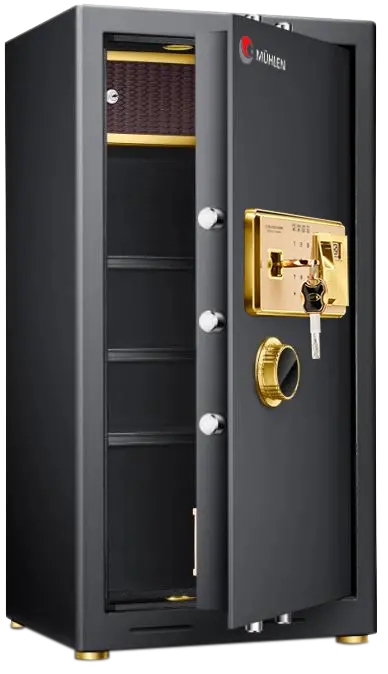
A steel safe is a security unit used to protect valuables such as cash, documents, jewellery, title deeds and digital media against risks like theft, fire and water. Choosing the right safe is not just a question of size: body thickness, opening method, fire resistance and installation type all have to be assessed together. In this guide we explain the types of steel safe, how to read the security indicators and how to choose the model that fits your needs.
Types of Steel Safe
The Mühlen range includes safe groups separated by use case:
Electronic (Code) Steel Safes
The most common group. They open with a digital code panel, a fingerprint reader or a combination of the two, and cover most home and office use. You can review all models in the steel safes category.
Fireproof Steel Safes
Built for heat-sensitive contents such as documents and cash; with certification from an independent test institute they keep the internal temperature at a safe level for a defined period. For details see our fireproof steel safe category.
Fire and Water Resistant Safes
These protect not only against fire but also against flooding, water ingress and extinguishing water. If you need this double protection, take a look at the fire and water resistant safes group.
Assembled / Wall-Mounted Safes
Used fixed to a wall or floor; this removes the risk of the safe being carried away and allows it to be concealed. Models are in the assembled steel safes category.
Bag (Portable) Safes
Compact safes with a carrying handle, designed both to store and to transport documents and cash — see bag cases.
Key Safes
Built to store large numbers of keys in an organised, locked manner; suitable for building management, hotels, fleets and estate agents. Models: key safe boxes.
Weapon Safes
Designed for the safe, access-controlled storage of licensed firearms — you can look at the weapon safes category.
Secret Safes
Safes produced to look like an everyday object such as a book or a power socket, hidden in plain sight. For details see the secret safes category and our article on secret steel safe models.
Opening Methods: Which Suits You?
- Digital code: the most common method. Mühlen models generally support a changeable code of 4–16 digits; the panel locks temporarily after failed attempts.
- Fingerprint (biometric): opens in seconds without carrying a key. Depending on the model, up to 30 fingerprints can be registered, and up to 255 on the Schutz-P series. Details: fingerprint steel safe.
- Key: the simplest method, requiring no electronics; it is also present on most models as an emergency key.
- Combination (code + key / fingerprint + code): requires two-layer verification; provides the highest access security.
- Motorised opening: the bolts retract automatically on the correct code or fingerprint, adding convenience.
How to Read the Security Indicators
Four headings determine the real level of protection a safe offers:
- Body and door thickness: the steel in the door should be thicker than the body. Mühlen models use structures such as a 10+10 mm double-layer steel door and a 7+7 mm double-layer body; the armoured insulation between the two layers provides resistance to both impact and heat.
- Number of locking points: how many points block the door (for example 4 moving + 3 fixed steel bolts) determines resistance to forced entry. A safe that locks at a single point is open to leverage.
- Fire resistance and certification: three values must be read together — the temperature withstood, the duration and the internal temperature threshold. Mühlen fireproof models are based on 2 hours of protection at 1010°C and keeping the internal temperature below 177°C (80°C on sensitive models). Because paper starts to char at around 177°C, the real protection lies in the internal temperature threshold. For 25 models in our range, independent American UL test certification is stated.
- Burglary testing: some models state forced-entry tests such as TL15X6, indicating resistance to sledgehammers, drills and cutting tools.
How to Choose the Capacity (Litres)
The Mühlen steel safe range runs from 10 litres to 390 litres. A practical approach:
- 10–25 litres: small-volume valuables such as passports, deeds, cash and jewellery; home and small office.
- 26–70 litres: medium size, able to hold folders and files; most office and business use.
- 70–150 litres: large numbers of documents and bulky items; accounting and archive units.
- 150 litres and above: corporate archives and high-volume storage; because of their weight these suit fixed installation.
When choosing, look at the internal dimensions: the external dimensions include the insulation thickness, and the real usable space is the internal measurement. Adjustable shelves let you use the volume efficiently.
Where Should It Be Installed?
- Fixing: safes light enough to be carried must always be fixed to a wall or floor; otherwise the whole safe can be taken away.
- Concealment: a safe placed in plain view becomes a target. Wall-mounted or secret safe models reduce this risk.
- Floor strength: models above 150 litres can weigh hundreds of kilos; the load capacity of the floor should be checked.
- Humidity and heat: do not place the safe directly next to a heat source or in a damp area; it shortens the life of the electronic panel.
Selection Checklist
- What will you protect? (paper documents → fire resistance; jewellery/cash → burglary resistance; digital media → low internal temperature)
- Is there a water risk? If so, choose a fire + water resistant model.
- How many people will have access? With multiple users, a biometric (fingerprint) model is an advantage.
- How much volume do you need? Calculate the internal dimensions and leave room for growth.
- Will it be fixed or portable? The assembled, secret and bag safe options differ.
- Is certification stated? An independent test certificate such as UL carries more weight than the manufacturer's own declaration.
Frequently Asked Questions
Is a steel safe fireproof?
Not every steel safe is fireproof; that is a separate manufacturing feature. On fireproof models the temperature withstood, the duration and the internal temperature threshold are stated separately.
Should I buy a code, fingerprint or key safe?
For a single user with infrequent access, a code or key is enough. For multiple users with frequent access, fingerprint models are practical; for the highest security, a combination (code + key) is preferred.
Should a steel safe be fixed to the wall?
Yes. Fixing safes that are light enough to carry is a basic condition of security; assembled models are built for this purpose.
How thick should a safe be?
The door should be thicker than the body. Mühlen models use structures such as a 10+10 mm double-layer door and a 7+7 mm body; the insulation between the layers provides both impact and heat resistance.
What happens if I forget the code?
Models offer an emergency key or a backup opening method; for that reason you should keep your key somewhere safe and separate from the safe.
Which safe suits a home?
For home use, models of 10–45 litres with a code or fingerprint that can be fixed to a wall are usually enough. For details see our home safe page.
Related Guides and Categories
- Steel Safes (all models)
- Fireproof Steel Safe · Fire and Water Resistant Safes
- Fingerprint Steel Safe · Home Steel Safe
- Assembled Steel Safes · Secret Safes · Bag Cases
- Key Safe Boxes · Weapon Safes
To identify the right model for you and request a quote, you can use the form on the product pages or get in touch with us.