
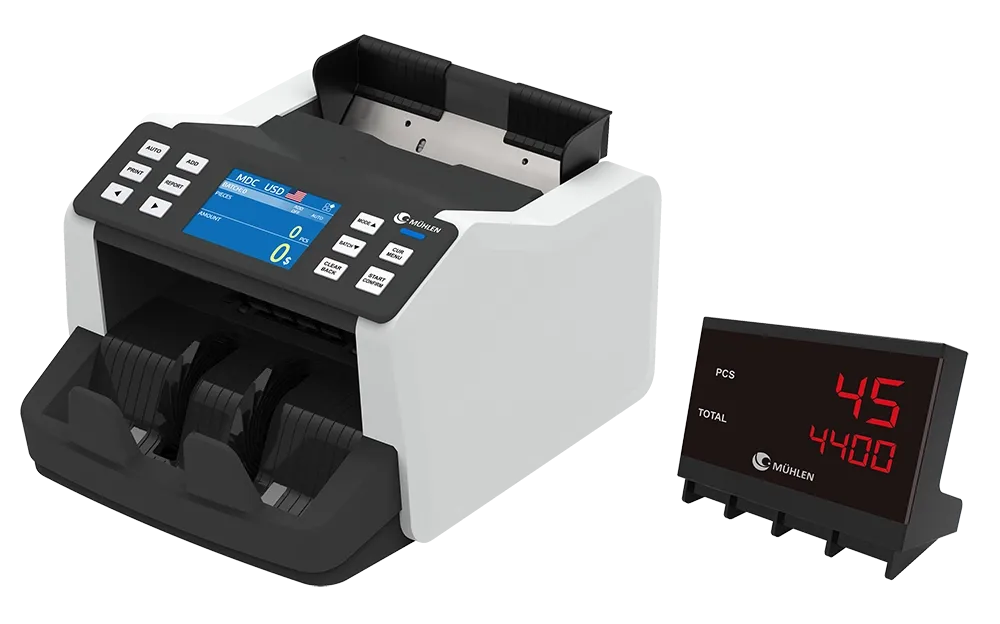
Money counting machines with counterfeit detection are devices that help identify suspicious banknotes while counting them. In businesses with heavy cash collection in particular, fast counting alone is not enough; the money being counted also has to be checked reliably.
For supermarkets, exchange offices, jewellers, fuel stations, hotels, accounting offices and any business with high cash turnover, counterfeit detection is a natural part of the operation. Choosing the right device saves time and reduces the risk that comes with manual checking.
How is counterfeit detection carried out during counting?
Modern money counting machines evaluate data from different sensors as the banknotes pass through. Depending on the model, technologies such as UV, MG, IR and CIS may be used. The device reads the physical and optical properties of the banknote and, in suspicious cases, warns the user or diverts the note to a separate pocket.
This structure matters especially at till closing. Instead of checking banknotes one by one by hand, staff can carry out counterfeit detection within the same flow as the count.
What do UV, MG, IR and CIS sensors mean?
UV detection
UV detection analyses the security areas on the banknote that respond to ultraviolet light. It is a simple and widely used layer of checking.
MG detection
MG, or magnetic detection, evaluates the magnetic properties on the banknote. It contributes to security verification particularly across different currencies.
IR detection
IR, or infrared detection, analyses the areas of the banknote that respond to infrared light. It forms an additional security layer in counterfeit detection.
CIS detection
The CIS sensor is an advanced reading technology that scans the banknote surface in greater detail. It offers a significant advantage for businesses that need multi-currency handling, mixed counting and more precise banknote recognition.
Which businesses need a model with counterfeit detection?
The greater the volume of cash collected, the greater the need for counterfeit detection. For exchange offices, jewellers, supermarket chains, fuel stations, bank-type operations and businesses with heavy till closing, models with advanced sensors may be the better choice.
While basic counterfeit detection can be enough for daily use, CIS-equipped or two-pocket professional models stand out in foreign exchange and high-volume cash operations. Models such as Mühlen Raptor B37, Mühlen Raptor B47, Mühlen Raptor C57 and Mühlen Raptor C67 can be considered in this group.
Why are two-pocket models an advantage in counterfeit detection?
Two-pocket money counting machines can keep the count running while diverting a suspicious banknote to a separate pocket. This feature prevents the count from stopping repeatedly and provides continuity in busy till operations. Mühlen Falcon L75, Mühlen Vision, Mühlen Vision M and Mühlen Falcon K88 are worth reviewing for professional use.
What if you only need counterfeit detection?
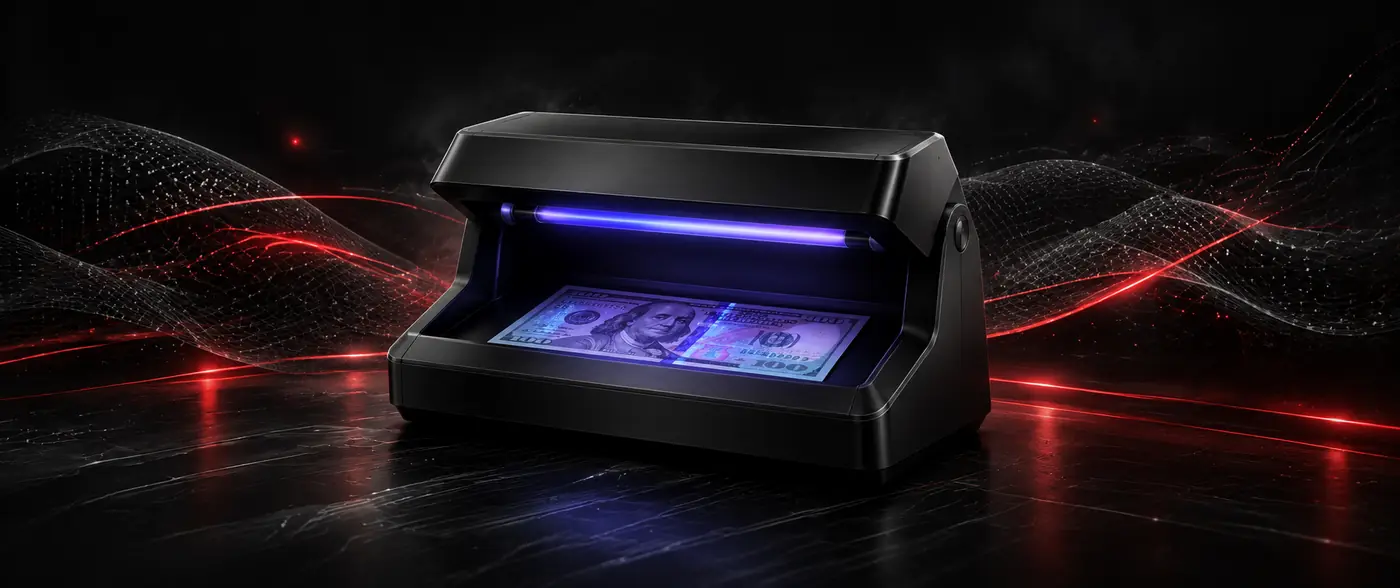
Not every business needs a money counting machine. If the task is only banknote verification, a separate money control machine may be more practical. If counting, value calculation and counterfeit detection are all required, however, the models in the money counting machines category offer a more complete solution.
Conclusion: counterfeit detection should not be reduced to a single sensor
The right approach in counterfeit detection is to choose the sensor combination according to the risk level of the business. Basic sensors can be enough for daily use; in foreign exchange, jewellery and high-volume cash processes, CIS, multi-currency support and a two-pocket separation structure provide a more professional solution.
How should the security level be determined when choosing a model?
The amount of cash the business takes in, the source of the banknotes and the variety of currencies handled determine the security level. In a business that mostly takes low-volume local-currency payments from the same customer base during the day, basic detection may be enough. In businesses that take high-value cash from varied customers, work with foreign currency or operate as a branch network, more advanced sensor combinations should be preferred.
The aim here is not only to catch a suspicious banknote. It also matters that staff can decide quickly, that the count is not interrupted and that a reliable record is produced at till closing. This is exactly where two-pocket models show their advantage: the main count can continue while the suspicious note is separated.
User habits matter in counterfeit detection too
Even with the right device, weak user habits mean the expected benefit is not achieved. Banknotes should be placed in the device correctly, warnings on heavily worn or folded notes should be examined carefully, and the cleaning/maintenance interval of the device should not be neglected. For the sensors to work properly, the device must be cleaned regularly under heavy use.
The best practice in a business is to define in advance what staff should do when a suspicious-note warning appears. That way the decision process does not vary from person to person during busy hours and a more standard cash control procedure takes shape.
Related Money Counting Guides
Before deciding on a device, you can review our guide on how to choose a money counting machine and, for busy till processes, our article on the counting process for heavy cash collection. For suitable models you can move on to the money counting machines category.
Frequently Asked Questions
Does a money counting machine with counterfeit detection give a definitive result?
These devices help identify suspicious banknotes. The final assessment should be made together with the sensor structure of the device, the condition of the banknote and a check by the user.
Is a CIS sensor necessary for every business?
It is not mandatory for every business. It does, however, offer a strong advantage for businesses with multi-currency handling, mixed counting and high security expectations.
Does counterfeit detection slow the count down?
On modern models the check runs as part of the counting flow. With the right model it reduces the manual checking load rather than slowing the operation.
Which sensors matter for an exchange office?
Multi-currency support and checking layers such as CIS, UV, MG and IR matter for exchange offices.
A separate counterfeit detector or a money counting machine?
If only verification is needed, a money control device may be enough. If counting, total value and reporting are also needed, a money counting machine should be preferred.