
In businesses with heavy cash collection, closing the till is not merely an end-of-day task; it is an operational process that demands speed, accuracy, security and reporting. Money counting machines make this process more controlled, reduce manual counting errors and let staff use their time more productively.
In supermarkets, fuel stations, exchange offices, jewellers, hotels, collection offices and businesses with a branch network, cash accumulates through the day. At the end of the day those banknotes have to be counted quickly, accurately and securely. At this point designing the right process matters as much as choosing the right device.
What should the basic flow be in a heavy cash operation?
A professional cash counting process generally consists of five steps: preparing the banknotes, counting with the device, counterfeit detection, verifying the total value and, where needed, reporting or printing. The more standard this flow becomes, the faster and more error-free the till closing runs.
Banknotes that are heavily worn, folded or mixed with foreign objects should not be fed into the device. Simple preparation before counting helps the device run more stably and keeps the count uninterrupted.
Counting money in supermarket and store operations
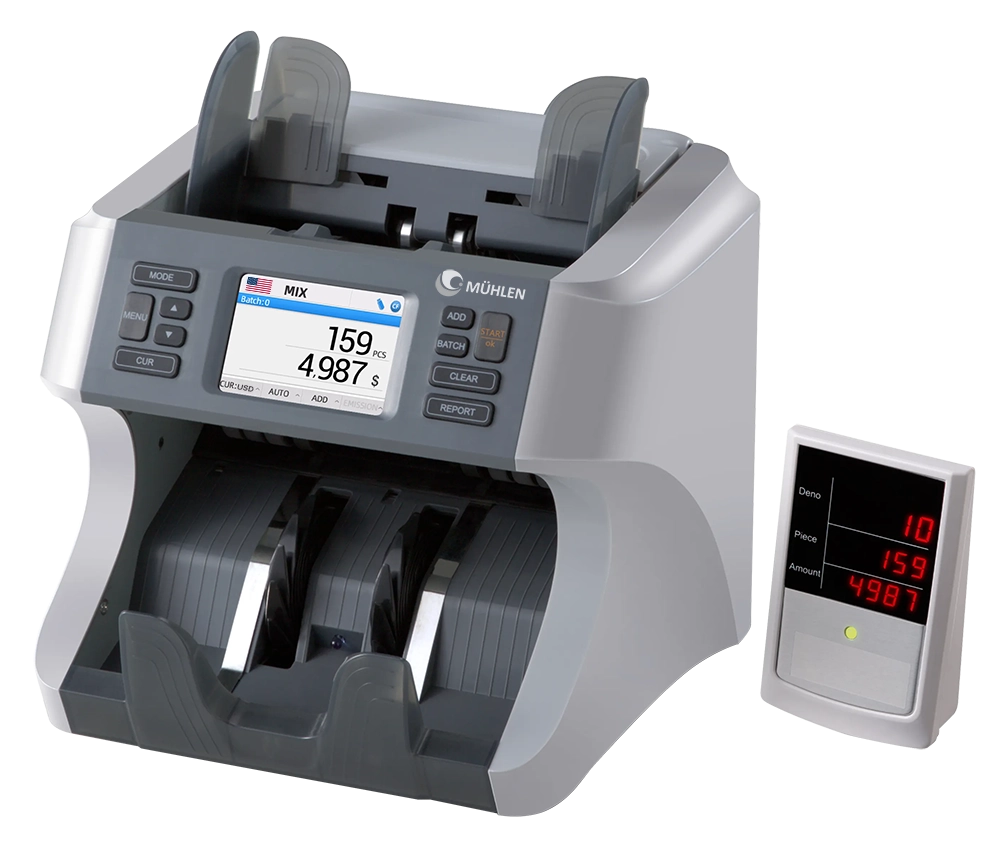
In supermarkets and stores the basic aim is to speed up the end-of-day till closing and reduce the manual counting load on staff. For frequently used currencies, fast counting, total value calculation and basic counterfeit detection may be enough. For this use, models such as MÜHLEN Raptor A17, Mühlen Master Mix 9330M and Mühlen Master 3 are worth reviewing.
The process is more demanding at exchange offices and jewellers
Because exchange offices and jewellers work with multiple currencies, currency recognition, mixed counting and advanced counterfeit detection become more critical. In these businesses the device's compatibility with EUR, USD, GBP and any other required currency should be assessed separately.
Models with a CIS sensor read the banknote surface in greater detail and provide a safer structure for multi-currency handling and counterfeit detection. For this need, Mühlen Raptor B37, Mühlen Raptor B47, Mühlen Raptor C57 and Mühlen Raptor C67 can be considered.
Fuel stations and multi-till structures
In businesses that collect cash from several tills during the day, such as fuel stations, regular reporting of the count is important. Device features such as add, batch, total value calculation and printer connection make separating the tills easier.
In operations where the count result has to be printed, thermal-printer-compatible solutions such as Mühlen Printer 2 can be used. Till closing can then be supported by a physical printout rather than only a verbal or handwritten note.
Two-pocket machines in high-volume operations
In businesses with heavy cash flow it is important that the count continues without stopping. Two-pocket money counting machines can keep the main count going by diverting suspicious notes, or notes that have to be separated, into a second pocket. This structure saves considerable time, especially in bank-type and professional cash operations.
Mühlen Falcon L75, Mühlen Vision, Mühlen Vision M and Mühlen Falcon K88 are among the professional models worth considering for this kind of intensive use.
Process design matters as much as the device
Even the best device will not deliver the expected benefit if it is used within the wrong process. Staff need to feed the device correctly, know how to act on suspicious-note warnings, record the count results and set up a regular maintenance plan. For that reason, usage habits should be planned alongside the device when buying a money counting machine.
Establish a standard till closing procedure
In businesses with heavy cash handling, every member of staff counting in a different way increases the risk of error. A standard procedure should therefore be defined for till closing. How banknotes are prepared, how the device is set to the correct mode, how suspicious-note warnings are assessed and how results are recorded should all be clear.
This standard structure matters especially in businesses working in shifts. At tills handled by different staff during the day, the counting process must not depend on the individual. If the total from the device, the manual till report and, where needed, the printout are checked together, reconciliation can be done faster.
A maintenance plan keeps the process running
Under heavy use, money counting machines can be affected by dust, banknote residue and ambient conditions. Regular cleaning and maintenance help the sensors work more reliably. Maintenance should not be neglected, particularly if counterfeit detection, currency recognition and mixed counting are to remain stable.
Naming someone in the business as responsible for the device, doing simple cleaning after daily use and scheduling a service check in busy periods all deliver long-term performance. This approach means the device is managed as a permanent part of the cash operation rather than as a one-off purchase.
Conclusion: speed, security and reporting belong together
For businesses with heavy cash collection, the counting process is not just about counting the number of banknotes. With the right device the process speeds up, counterfeit risk is managed more tightly and till closing becomes more orderly. To see the models that suit your business, review the Mühlen money counting machines category.
Related Money Counting Guides
Before designing the process, you can review our guide on how to choose a money counting machine for the right device criteria, and our article on money counting machines with counterfeit detection for the security layer. For all models you can use the Mühlen money counting machines category.
Frequently Asked Questions
Which features matter for businesses with heavy cash handling?
Mixed counting, counterfeit detection, multi-currency support, reporting, printer compatibility and service support are the priority features.
What should be done to speed up till closing?
Banknotes should be arranged before counting, the device should be used in the correct mode and the daily till procedure should be standardised.
Is a printer connection necessary for fuel stations?
In businesses with multiple tills and shift tracking, taking a printout of the count can be useful for reporting.
Is a standard money counting machine enough for an exchange office?
Because multi-currency handling, mixed counting and advanced counterfeit detection are usually required, models with a CIS sensor are more suitable.
Are two-pocket machines necessary for every business?
They are not mandatory for every business. They do, however, offer a significant advantage in high-volume operations that require uninterrupted counting.