
Short answer: No, not every money counting machine separates counterfeit notes. Economical models that only count pieces do not check whether a banknote is genuine; machines with UV, MG and IR detectors catch a suspicious note during the count and give an audible warning or separate it. Models with a CIS sensor that count mixed denominations offer the most comprehensive protection. The right choice depends on your business's cash volume and risk level.
Which Money Counting Machines Detect Counterfeits and Which Only Count?
There is no single answer to "does a money counting machine detect counterfeits?", because the devices on the market fall into three classes. The difference is whether the machine only asks "how many are there?" or interrogates every banknote through its security features. Knowing these three classes while reviewing the models in the money counting machines category stops you spending your budget on the wrong device.
Machines that only count pieces
The most basic class: it counts banknotes at high speed and gives the number at the end of the bundle. It takes no interest in whether the banknote is genuine or counterfeit; a counterfeit note mixed into the bundle is counted along with the real ones and enters your till. Other than in businesses with low cash volume and a reliable source of banknotes, this class is rarely recommended today.
Machines with UV, MG and IR detectors
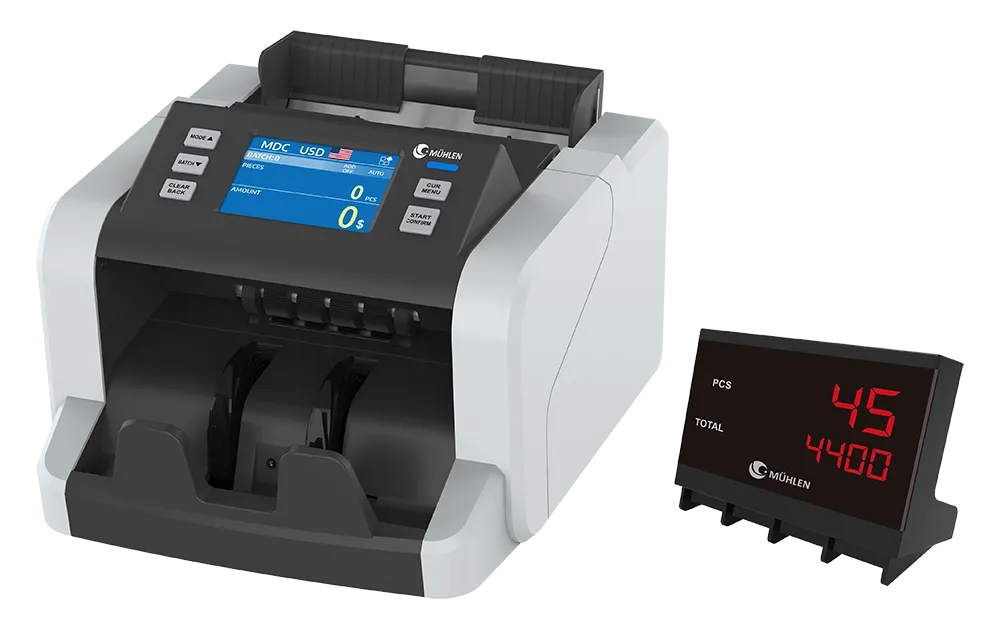
Devices in this class pass every banknote through one or more sensors at the same time as counting: ultraviolet (UV), magnetic ink (MG) and infrared (IR) checks. When a suspicious note is detected the machine stops the count and gives a warning. Even economical models such as the Mühlen Raptor A17 offer this protection as standard; it is a practical entry point for businesses counting banknotes intensively at the till.
Machines with a CIS sensor that count mixed denominations
The most advanced class works with CIS (Contact Image Sensor) technology. CIS scans a high-resolution image of both sides of the banknote; this lets it both recognise a mixed bundle denomination by denomination and calculate the total value, and compare the image with a genuine banknote template, taking counterfeit detection to a higher level. The Raptor C57 CIS mixed money counting machine and the two-pocket, bank-style Mühlen Vision are examples of this class.
Comparison at a Glance: What Does Each Device Do?
| Device type | Counterfeit detection | Counting capability | Who it suits | Price |
|---|---|---|---|---|
| Piece-counting machine only | None | Counts pieces, does not read denomination value | Businesses with low cash risk working in a single denomination | Request a quote |
| Money counter with UV/MG/IR detectors | Yes — automatic during the count | Piece counting + simultaneous counterfeit check | Supermarket, store, busy front-of-till retail | Request a quote |
| Mixed counter with CIS sensor | Yes — UV/MG/IR + image analysis | Counts a mixed bundle by value, denomination by denomination | Bank-style institutions handling heavy cash, chains | Request a quote |
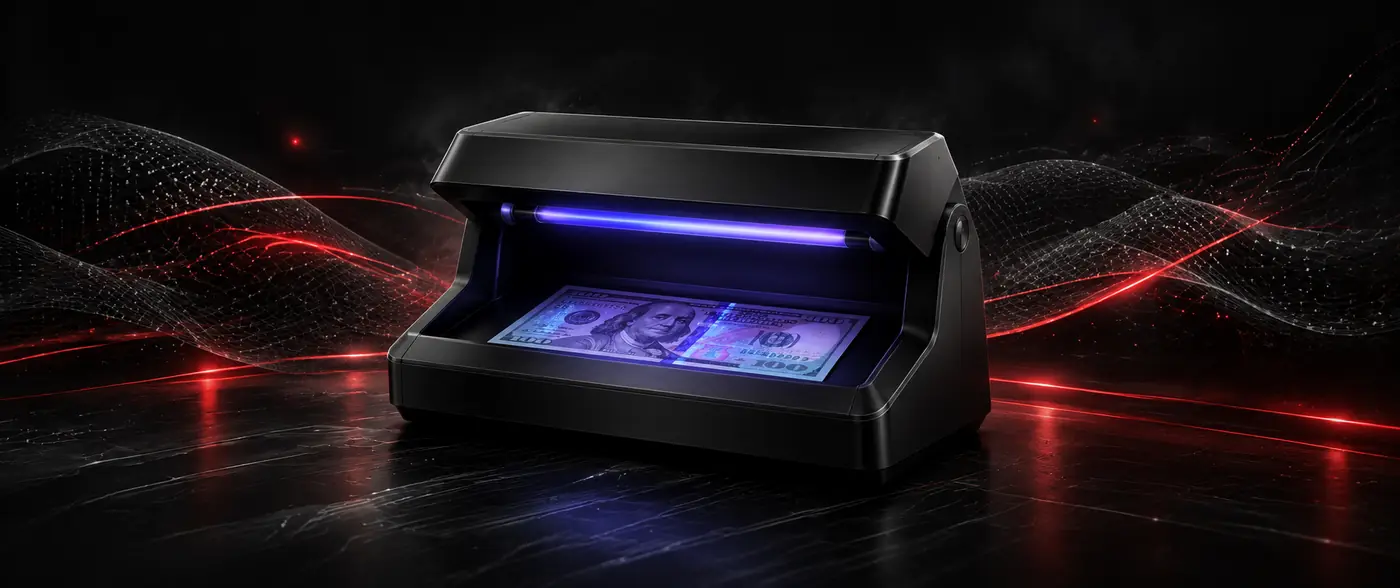
| UV light money checking device | Yes — visual UV check | Does not count; banknotes are checked one by one | Jewellers, exchange offices, small traders | Request a quote |
What Is UV (Ultraviolet) Checking and Where Does It Look on the Banknote?
UV checking illuminates the banknote with ultraviolet light invisible to the human eye. Genuine banknote paper is specially produced and stays matt under ultraviolet light; by contrast the fluorescent fibres scattered through the note, certain printed areas such as the value figure, and the security features glow clearly. On counterfeit notes the picture is usually reversed: because ordinary paper is used, the background gives off a whitish glow, and the fibres and patterns that should glow are either not visible at all or are in the wrong place.
For those wondering "can a counterfeit note be identified with ultraviolet light?", in short: UV is the most common and fastest first check, but on its own it does not give a final verdict. High-quality counterfeiting may try to imitate the UV response. That is why professional devices use UV together with MG and IR.
How Do MG and IR Checks Work?
What does MG mean on a money counting machine?
MG is the abbreviation for magnetic checking. On genuine banknotes the security thread and certain printed areas are printed with special ink that carries magnetic properties. The machine's magnetic sensor reads this trace as the banknote passes through. Because counterfeit notes produced by photocopying or standard printing have no magnetic trace, the MG sensor rejects the note immediately. If you see an "MG error" on the display or in the audible warning, the machine has failed to find the magnetic trace that should be on the banknote.
IR (infrared) checking
IR checking looks at the banknote with infrared light. The design of genuine banknotes is printed with two different ink behaviours: some areas absorb infrared light, others reflect it. As a result, part of the banknote image "disappears" under IR while part stays visible — and this pattern is specific to each denomination. Because this distinction does not occur on counterfeit notes, the IR sensor catches the difference immediately. IR is regarded today as one of the most reliable filters against counterfeits produced on a colour printer.
In short, the three technologies cover each other's gaps: UV interrogates the paper and the fluorescent features, MG the magnetic ink and IR the printed pattern. So when buying, you should choose a model with at least UV+MG, and preferably UV+MG+IR, rather than a single sensor.
What Does the Machine Do When It Catches a Counterfeit?
When a suspicious banknote is detected, the device behaves in one of three ways depending on the model:
- Stop and warn: single-pocket machines stop the count and give an audible and on-screen warning; the suspicious note is on top of the bundle, is removed by hand and counting continues.
- Reject pocket: two-pocket and bank-type models send the suspicious note to a separate pocket; the count continues without any interruption. This saves a great deal of time in businesses handling heavy cash.
- Error code: the display shows which check it failed, as a UV, MG or IR error, so you know where to look when examining the banknote by hand.
An important warning: not every banknote the machine rejects is definitely counterfeit. Worn, torn or taped genuine banknotes can also mislead the sensors. Set the suspicious note aside and follow the official procedure described in the FAQ section below.
Only Need Checking? UV Light Money Checking Devices
If you are not counting bundles of notes through the day and only want to verify the banknotes you take one by one, you do not need a separate money counting machine: compact devices, also known as counterfeit detectors, are made for this. The money control machines category contains two approaches. The first is UV light models: you hold the banknote under the UV lamp and check the areas that should glow by eye; the battery-powered, multi-function Violet Smart UV light money checking device is a typical example for counter-top use. The second is automatic devices: models such as the Zoom 4 automatic counterfeit detector draw the banknote in, interrogate it with several sensors and report the result without leaving the judgement to you. For jewellers, exchange offices and fuel stations this compact class is often enough.
Frequently Asked Questions
Does a money counting machine catch counterfeits one hundred per cent of the time?
A claim of "one hundred per cent" would not be honest for any device; but a current machine that uses UV, MG and IR checks together reduces the risk many times over compared with a check made by hand or with a single sensor. When CIS image analysis is added, detection power reaches its highest level. What matters is that the device runs several technologies at the same time.
Is UV checking alone enough?
For low-volume, face-to-face takings a UV light checking device is a good first line of defence; but UV alone can be fooled by high-quality counterfeiting. We recommend at least UV+MG for every business that counts notes in bundles, and a UV+MG+IR or CIS model for those handling heavy cash.
What should I do if a counterfeit note comes out of the machine?
Never put the suspicious banknote back into circulation; knowingly using counterfeit money is a criminal offence. Set the note aside and hand it in to the nearest bank branch or to the police; the bank takes the note against a record and sends it for examination. If the note turns out to be genuine, its value is returned to you.
Can a counterfeit detector be added to my piece-counting machine later?
No; UV, MG and IR sensors are factory hardware and cannot be fitted afterwards. If you have a machine without detectors, the most practical solution is to buy a compact counterfeit detector alongside it, or to replace your device with a model that has detectors.
Does a mixed money counter also check for counterfeits while counting value?
Yes. Mixed counting already relies on the CIS sensor recognising the banknote as an image; UV, MG and IR checks are carried out during the same scan. So when you buy a model that counts mixed denominations, counterfeit protection comes as a natural part of that function.
Let Us Choose the Right Device Together
Your daily cash volume, the number of tills and your working tempo determine which class suits you: for some businesses a compact UV light device is enough, while others need a model with a reject pocket and a CIS sensor. As the Mühlen team we listen to your use case and recommend the most suitable model with clear reasons. Write to us on our WhatsApp line or request a quote from our contact page; let us determine the right money counting or money checking device for your needs together.