
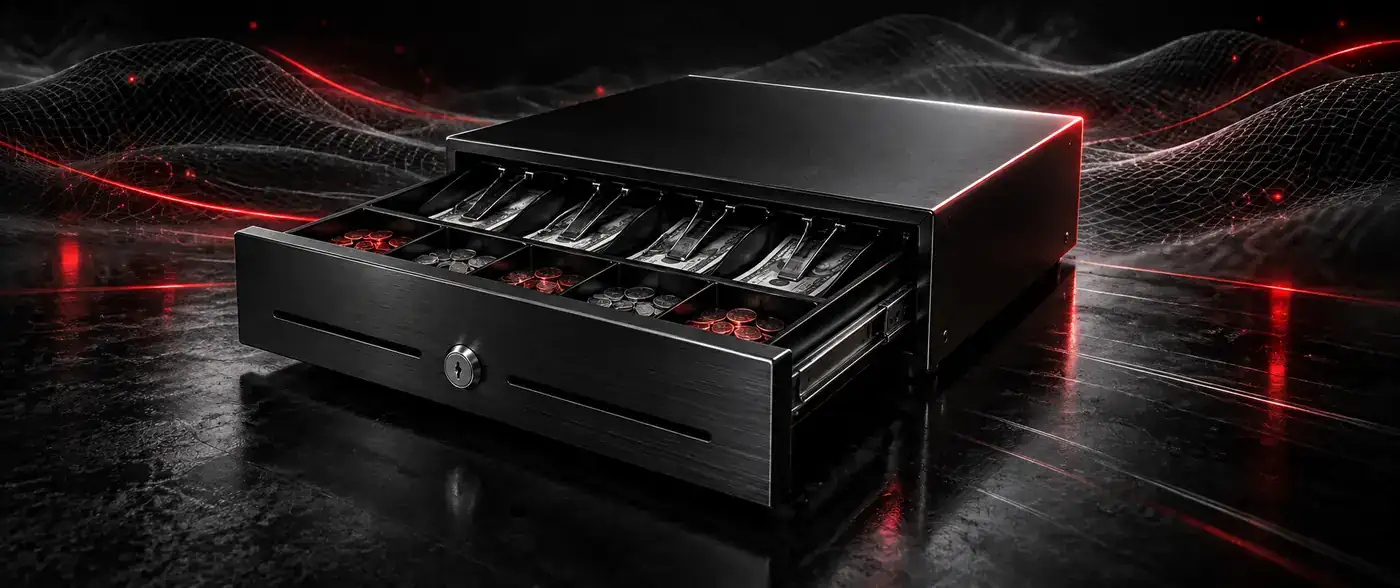
How to Choose a Cash Drawer: Cash Register Drawer and Lockable Cash Box Guide
Cash drawer buying guide: cash register connection (RJ11), coin and note compartments, 3-position lock, 1–3 million cycle test, lockable cash boxes and model advice by business.
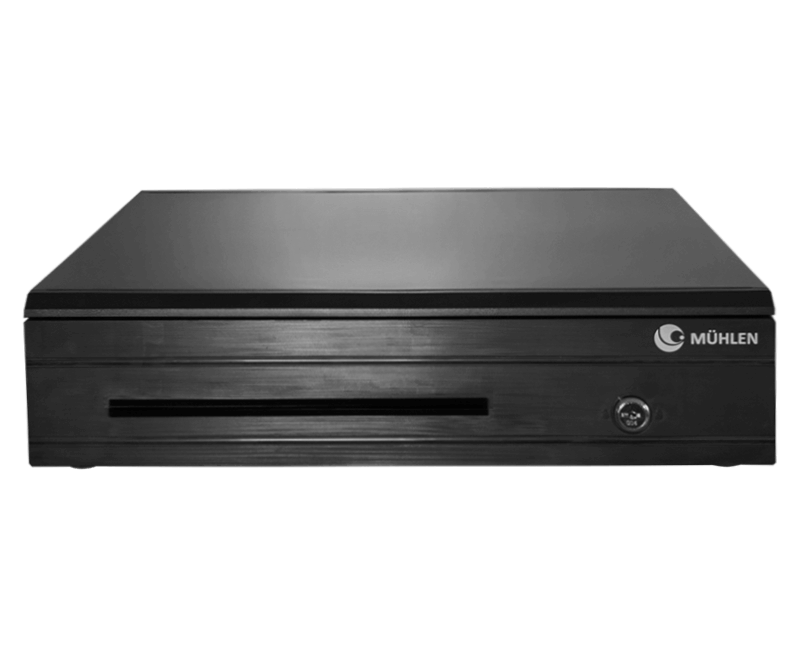
A cash drawer (cash register drawer) is a lockable drawer that keeps the cash taken at the till sorted by denomination and opens automatically when a sale is completed, because it is connected to the cash register or receipt printer. A cash box does the same job with a portable, lockable box that is opened by hand; it is used at markets, kiosks, events and at home. The right choice depends on the connection to your cash register, the space on the counter, the number of transactions per day and how many denominations you work with. All models are in our cash register drawers and cash boxes categories.
Last updated: 24 November 2026
Short answer: For a fixed till in a supermarket, pharmacy, café or shop, choose a metal cash drawer with a 3-position lock that connects to the cash register with an RJ11 cable. If the counter is narrow, a compact or top-opening model suits; for a busy till, a model with telescopic rails tested for 3 million openings. If there is no cash register or the till keeps moving (market stall, kiosk, trade fair, car park booth), a lockable cash box with a carry handle is enough. Drawers and boxes are for daytime use; at the end of the day the cash should go into a steel safe.
What Is a Cash Drawer For?
A cash drawer lets the cashier give change quickly, keeps denominations from getting mixed up and exposes the cash only at the moment of sale. When the receipt is issued, the cash register sends an open signal to the drawer, which slides out on a spring mechanism; when the cashier finishes and pushes it back, it locks. This way the drawer does not open outside a sale, every opening is linked to a sale and the chance of a difference in the end-of-day count is reduced.
Three products are often confused:
- Cash drawer (cash register drawer): placed under the counter or under the cash register, connected by cable, opens with a sale.
- Cash box (lockable cash box): not connected, opened by hand with a key, has a carry handle.
- Money safe: a steel safe fixed to the wall or floor where cash is kept overnight and at weekends. Drawers and boxes do not replace a safe. Details: how to choose a money safe.
Types of Cash Drawers
Front-Opening Cash Register Drawers
The most common type. It sits under the cash register or POS screen and slides out to the front. Mühlen's EU 2550, EU 2570, EU 3550-S and the XL-size EUP 5555 belong to this group. The economical entry model is the EU 2480.
Compact and Heavy-Duty Drawers
Developed for tills with little counter space but heavy customer traffic. The ES 4460 is designed to hold as much cash as large drawers despite its compact body; the DS 3362, with 8 note compartments, is the model that separates the most denominations. Both have telescopic rails and have been tested for more than 3 million open-close cycles.
Top-Opening Drawers
The lid opens upwards, so no space is needed in front for the drawer to slide out. Suitable for narrow counters, wholesale points and in-office payment desks. Example: TP 460.
Portable Cash Boxes
Boxes without a cash register connection that lock with a key and have a carry handle. This group includes the metal Cash Box CB150, CB200 and CB300 and the aluminium B198, B398 and B598.
Drawer-Type Combination Safes
A solution between a cash drawer and a steel safe: it opens like a drawer but locks with a digital code. It is used to take surplus cash from the cashier's drawer during the day, or to store a laptop and cash together in places such as hotels and offices. Examples: Oben KS333 and the top-lid Oben KS222.
Connecting to the Cash Register: How Does the Drawer Open?
Mühlen cash drawers connect to the cash register or receipt printer with an RJ11 cable; on the EU 2550, EU 2570 and TP 460 the cable is 1.5 metres long. When a sale is completed, the cash register sends a short electrical signal through the drawer port, the lock latch in the drawer releases and the drawer opens.
- Compatibility: RJ11 connection is used by almost all cash registers and POS systems. Still, check the drawer port of your cash register or receipt printer before buying; if you are not sure, give your device model in the quote form.
- Where to connect: on some systems the drawer connects directly to the cash register, on others to the receipt printer. The drawer-open setting in the POS software must be enabled.
- Power cut or no connection: on models with a 3-position lock the drawer is opened by hand by turning the key to "open"; the EU 2480 also has an emergency release button for this. The EU 2570 is designed for both automatic use connected to the cash register and manual use with the key.
Size and Counter Layout
Before choosing a drawer, measure the counter: width, depth and the space the drawer needs when it slides open. The net dimensions of all models and the RJ11 connection steps are in our cash drawer dimensions article. Front-opening models slide out by a large part of their depth when open; this distance must stay clear in front of the cashier.
- Shallow counter: ES 4460 (30.5 cm) or the top-opening TP 460 (17 cm). Narrow counter: DS 3362 (34.6 cm).
- Standard: EU 2480 (base 368x336 mm), EU 2550, EU 2570.
- Wide / XL: EU 3550-S and the 46x43x12 cm EUP 5555; for supermarket tills with several cashiers.
If there is no room on the counter, the drawer can be hung under the counter with the Mühlen Slide mounting rails. The 1 mm steel rails are made in three sizes, are compatible with the EU 3550-S, EUP 5555, EU 2550, ES 4460 and DS 3362, and come with a 36-month warranty. The drawer is out of sight and within easy reach at the cashier's knee level.
Compartments: Coins, Notes and a Hidden Slot
You need as many compartments as you have denominations. Considering the coins and notes in circulation, 8 coin compartments and 4–5 note compartments are a comfortable layout for most businesses.
- Coin compartments: most Mühlen cash register drawers have 8 with adjustable widths; the DS 3362 has 6 resizable compartments.
- Note compartments: 4 on the EU 2480; 5 on the EU 2550, EU 2570 and EU 3550-S; 6 on the TP 460; 8 on the DS 3362. Metal clips hold the notes in place and stop them lifting when the drawer opens and closes quickly.
- Hidden note slot: a slit for dropping a large note inside without opening the drawer; it keeps high denominations out of sight of the cashier and the customer. There is 1 on the EU 2480, EU 2550, EU 3550-S, TP 460, ES 4460 and DS 3362, and 2 on the EUP 5555.
- Removable tray: at a shift change the whole tray is taken out to the counting room; the new cashier starts with their own tray.
Lock and Security
Most Mühlen cash register drawers (EU 2550, EU 2570, EU 3550-S, EUP 5555, ES 4460, DS 3362, TP 460) have a 3-position key lock:
- Automatic: normal operating position; the drawer opens only on the cash register signal.
- Locked: the drawer is locked and does not open even if the cash register sends a signal. Used when the cashier leaves the till or at the end of the shift.
- Open: the drawer can be opened by hand without a signal; for power cuts and counting.
A cash drawer is for cashier convenience and control; it is not a safe against theft. Take surplus cash out of the drawer at regular intervals during the day; a deposit-type safe lets you do this without opening the drawer (see CS60). Do not leave cash in the drawer overnight; leaving the empty drawer in the open position also prevents it from being forced and broken in a break-in. For choosing a business safe, see our article on safe solutions for businesses.
Durability: 1 Million or 3 Million Open-Close Cycles?
The life of a drawer is set by its rails and lock mechanism. Manufacturers state this with an open-close test:
- Tested for more than 1 million cycles: EU 2570 and EU 3550-S. For medium-traffic supermarket, café and shop tills.
- Tested for more than 3 million cycles: EUP 5555, DS 3362, ES 4460 and TP 460. These telescopic-rail models are for supermarkets, petrol stations and tills worked in shifts.
A simple calculation: a drawer opened 300 times a day opens about 110,000 times a year; a 1-million test corresponds to about 9 years of use, a 3-million test to three times that. At tills with several cashiers that run 24/7, the 3-million class should be preferred. The body material also matters: a metal body and a stainless front panel (EU 2550) prevent scratches and rust on the front that is constantly touched.
How to Choose a Lockable Cash Box
For businesses that do not use a cash register or whose till moves around, a cash box is the most practical solution. Look at five things when choosing:
- Size: the mini CB150 (15x20x8 cm, about 0.5 kg) is for small change and small collections; the CB300 (30x24x9.5 cm) and B598 (335x275x115 mm) are for points that take payments all day.
- Compartment layout: the CB150 has 6 coin compartments; the CB200 comes with 4 coin compartments and 1 note compartment. If you handle many notes, choose models with clipped note compartments: 1 on the B198, 2 on the B398, 4 on the B598 and CB300.
- Body: the Cash Box series is all metal; the B series has a light aluminium body (B198 1 kg, B398 1.32 kg). Aluminium is better if the box is carried by hand for long periods, a metal body if it stays on the counter.
- Lock: a key lock is standard. The Cash Box CB150, CB200 and CB300 have a metal hook lock, the B series an open/close key lock; the B198 locks automatically when the lid closes. The models come with a main and a spare key; keep the spare key away from the box.
- Carrying: a folding or steel carry handle makes it easy to take the box to the safe at the end of the day.
Because a cash box is portable, the box itself can be stolen; in crowded places it should be kept under the counter and out of sight, and the cash in it should go into the safe at the end of the day. At home, the CB150 or CB200 is enough for pocket money and small savings.
Mühlen Cash Drawer and Cash Box Comparison Table
Values are taken from the technical specifications on the product pages; click the model name for details.
| Model | Type | Compartments | Connection / lock | Key feature |
|---|---|---|---|---|
| EU 2480 | Cash register drawer | 8 coin + 4 note | RJ11 | Economical entry model, emergency release button |
| EU 2550 | Cash register drawer | 8 coin + 5 note | RJ11 (1.5 m), 3-position lock | Metal body, stainless front panel |
| EU 2570 | Cash register drawer | 8 coin + 5 note | RJ11 (1.5 m), 3-position lock | Automatic and manual key use, 1 million+ test |
| EU 3550-S | Wide drawer | 8 coin + 5 note | Standard cable, 3-position lock | Metal clips, 1 million+ test |
| EUP 5555 | XL drawer | 8 adjustable coin + clipped note compartments | Standard cable, 3-position lock | 46x43x12 cm, telescopic rails, 3 million+ test |
| ES 4460 | Compact, heavy duty | 8 coin + 6 note | Cable + socket, 3-position lock | Narrow counter, quiet telescopic rails, 3 million+ test |
| DS 3362 | Heavy duty | 6 coin + 8 note | 3-position lock | Industrial steel, hidden slot, 3 million+ test |
| TP 460 | Top-opening | 8 coin + 6 note shelf | RJ11 (1.5 m), 3-position lock | Compact, 3 million+ test |
| Slide | Mounting rails | — | — | Under-counter mounting, 3 sizes, 36-month warranty |
| Cash Box CB150 | Mini cash box | 6 coin | Hook lock, 2 keys | 15x20x8 cm, about 0.5 kg, removable tray |
| Cash Box CB200 | Medium cash box | 4 coin + 1 note | Hook lock, 2 keys | Metal body, steel carry handle |
| Cash Box CB300 | Cash box / drawer | 5 coin + 4 note | Hook key lock | 30x24x9.5 cm, steel clips |
| B198 | Mini portable drawer | 4 coin + 1 note | Locks when closed | Aluminium, 1 kg, folding handle |
| B398 | Medium portable drawer | 4 coin + 2 note | Key lock (2 keys) | 290x205x110 mm, 1.32 kg |
| B598 | Large portable drawer | 4 coin + 4 note | Key lock (2 keys) | 335x275x115 mm interior |
Model Recommendations by Business
- Supermarket, petrol station, multi-cashier till: EUP 5555 or DS 3362 (3 million+ test, telescopic rails).
- Grocery, convenience store, shop: EU 2550, EU 2570 or EU 3550-S.
- Pharmacy, café, narrow counter: ES 4460 or the top-opening TP 460; if there is no room, under-counter mounting with the Slide rails.
- Restaurant: EU 2570 connected to the cash register; for service staff, a cash box such as the CB300 as well.
- Market, kiosk, mobile sales: B198 or B398 (light aluminium, carry handle).
- Trade fair, event, car park booth: B598 or CB300 (all-day collection, clipped note compartments).
- Home and personal use: CB150 or CB200.
End of Day: Counting, Checking and Storage
The cash drawer is the first link in the cash flow. At the end of the day the cash in the drawer is counted, checked for counterfeit notes and put in the safe:
- Counting: the more notes there are, the slower and more error-prone hand counting becomes; for note counting and value calculation see our money counting machine guide. Models: money counting machines.
- Checking: counterfeit detectors are used to set aside suspicious notes at the till during the day.
- Storage: the counted cash is kept overnight in a fixed steel safe. See our steel safe guide for choosing one.
Frequently Asked Questions
Does a cash drawer connect to every cash register?
Mühlen cash register drawers connect with an RJ11 cable and are compatible with almost all cash registers and POS systems on the market. Check your device's drawer port before buying; if you are not sure, give your cash register model in the quote form.
What are the dimensions of a cash register drawer?
It depends on the model. The ES 4460 (30.5 cm) and the top-opening TP 460 (17 cm) are for shallow counters; the standard EU 2480 has a base of 368x336 mm and the XL EUP 5555 measures 46x43x12 cm. With front-opening models, also allow for the space the drawer needs when it slides open.
How do you open the drawer during a power cut?
On models with a 3-position lock the drawer is opened by hand by turning the key to "open". That is why the key should be kept by an authorised person, separate from the cashier.
How many compartments should a cash drawer have?
For most businesses 8 coin compartments and 4–5 note compartments are enough. Businesses that work with many denominations or also accept cheques and vouchers should choose models with 6–8 note compartments and a hidden note slot.
What is the difference between a cash box and a cash drawer?
A cash drawer connects to the cash register and opens with a sale; it stays fixed on the counter. A cash box is not connected, is opened by hand with a key and has a carry handle; it suits sales points that move around, such as markets, kiosks and events.
Can a lockable cash box be used at home?
Yes. Compact metal boxes such as the CB150 or CB200 are suitable for pocket money, change and small savings. For larger amounts and valuables, a steel safe fixed to the wall is needed.
Can a cash drawer be mounted under the counter?
Yes. The Mühlen Slide mounting rails are made in three sizes and allow under-counter mounting with models such as the EU 3550-S, EUP 5555, EU 2550, ES 4460 and DS 3362.
How long does a cash drawer last?
Lifetime is measured with an open-close test. Mühlen models have been tested for more than 1 million (EU 2570, EU 3550-S) or 3 million (EUP 5555, DS 3362, ES 4460, TP 460) open-close cycles; at 300 openings a day, 1 million cycles correspond to about 9 years.
Who prepared this: The Mühlen expert team at Karadeniz Dış Ticaret, the Mühlen distributor in Türkiye. How it was prepared: Model values were taken from the technical specifications on the product pages; values not found in the product data were not written or were left as "not specified". The text was written with AI assistance. Why: So you can compare the options that fit your needs before choosing a model.
Related Content
For all models see our cash register drawers and lockable cash boxes categories; for a model comparison, our cash drawer models and comparison article. For storing cash overnight, our steel safe guide and how to choose a money safe, and for counting, our money counting machine guide show the way.
To find the right model and request a quote, use the form on the product pages or contact us.