
Renting a money counting machine makes sense only for an event lasting a few days or for short-term seasonal peaks. In businesses that count cash regularly, monthly rental fees add up quickly and approach the purchase cost of the device; advantages such as warranty, a menu in your language and continuity of service, meanwhile, are permanent only with a purchase. For continuous use, buying almost always works out more economical.
If yours is a business with cash moving through the till every day, it is entirely natural to ask this question: should you invest in a device up front, or pay monthly rent instead? In this article we compare, in a neutral frame, the scenarios in which renting really works, its overlooked costs and the long-term advantages of buying. The aim is to let you make the right decision for your business's cash volume.
Why Does Renting a Money Counting Machine Come Up?
The idea of renting generally arises in two situations: either the cash intensity is temporary (a trade fair, a festival, a stocktaking period) or the business does not want to set aside a budget for the device up front. At first glance renting promises a "low entry cost"; but a money counting machine does not have a widespread rental market like a photocopier. The number of firms offering this service is limited, the choice of devices is narrow, and rented machines are often older models that have seen heavy use. The decision should therefore not be reduced to "rent or instalments" but made on the basis of duration of use, device reliability and service assurance.
When Does Renting Make Sense?
Let us be honest: there are scenarios in which renting really is an advantage. But what they have in common is that the use is short and non-repeating.
Short-term events and organisations
At organisations such as a trade fair, festival, concert box office, charity sale or fundraising campaign lasting a few days, cash volume rises suddenly and then drops to zero. If you will need the device for only a few days, renting or buying it as a service is a reasonable solution.
One-off seasonal counting
Renting can also be considered for one-off intensive counting periods such as year-end inventory or a handover. But there is a critical distinction here: if the season repeats every year (the New Year period, the tourist season), the rental fees paid again each year exceed the cost of the device within a few seasons. Recurring intensity is an argument for buying, not for renting.
The need to try before buying
Some businesses use renting as a way of testing whether the device fits their workflow. A more practical route, however, is to speak to the supplier directly and determine the right model together; describing your banknote volume and counting routine often gives a more accurate result than weeks of trialling.
The Overlooked Costs of Renting
The rental fee itself is the visible part of the iceberg. These items also have to be taken into account when deciding:
- Accumulating rental payments: although the monthly fee may look small on its own, once use is measured in months the total quickly approaches the price of an entry-level device.
- Deposit and liability for damage: under most contracts the renter is liable for any fault or damage to the rented device.
- The risk of an old, worn device: rental machines work by changing hands; a device with dusty sensors and worn feed rollers produces counting errors and banknote jams.
- Uncertain compatibility with current banknotes: an older device whose software has not been updated may show weaknesses with banknote series in circulation and in counterfeit detection.
- No guarantee of continuity: if your need drags on, there is no assurance that the same device will be available or that the contract terms will not change.
The Advantages of Buying: Warranty, Native-Language Menus, Continuity of Service
Warranty assurance
A new device you buy is covered by warranty: every problem arising from manufacture is resolved at no extra cost. With renting the warranty belongs to the device's owner; you rent only the right of use, and your business is left without a device while a fault is dealt with.
Menus in your language and ease of use
Mühlen devices prepared for the Turkish market run with a Turkish interface; your cashier or accounts staff start counting on day one without training. With rented devices you often have no choice about the interface language.
Continuity of service and spare parts
A money counting machine is a mechanical device: rollers, belts and sensors need maintenance over time. When you buy, you manage your device's service history yourself; continuity of spare parts and technical support carries on for years through the distributor. With renting, the device's maintenance history is a black box to you.
Asset value and predictable cost
A purchased device is an asset of your business; its cost is known, paid once, and it serves for years. With renting the payment continues indefinitely, and it is no surprise for the fee to rise at contract renewal. Because the tax side (expensing rent, depreciation) varies by business, we recommend clarifying that detail with your accountant.
Comparison Table: Rent or Buy?
| Criterion | Renting | Buying |
|---|---|---|
| Initial cost | Low (monthly fee + deposit) | One-off device price |
| Long-term total cost | Rises continuously the longer you use it | Fixed; paid once |
| Warranty | None (belongs to the device owner) | Yes; manufacturing problems are covered |
| Device condition | Usually used, history unknown | New, current series |
| Service and spare parts | Dependent on the rental firm | Continuity under distributor assurance |
| Native-language menu / spoken prompts | Uncertain, depends on the model | The choice of model is yours |
| Ownership | None; the device goes when the contract ends | Stays as a business asset |
| Suitable scenario | A few days' event, one-off counting | Regular, recurring cash counting |
Payback Logic: When Does a Purchased Device Pay for Itself?
Although the figures vary from business to business, the logic of the payback calculation is always the same and rests on two simple comparisons:
1) Compare the rental total with the device price. Multiply the monthly rental fee by the number of months you plan to use it. If that total approaches or exceeds the price of an entry-level device, renting turns from that point into a model that continuously loses you money. With regular use this threshold is usually reached in less than a year; the device, meanwhile, keeps working for years.
2) Add the invisible cost of counting by hand. The time staff spend on the till count every day, the counting errors that grow with fatigue and the risk of a counterfeit note slipping through cost more than the device itself in most businesses. Money counting machines with counterfeit detection eliminate this risk automatically during the count; with manual counting you are entirely dependent on staff attention.
In short: if cash counting is part of your business's weekly routine, the question stops being "rent or buy" and becomes "which model". You can review every option, from entry level to bank-type devices, in the money counting machines category.
A Budget-Friendly Start: Mühlen Raptor A17
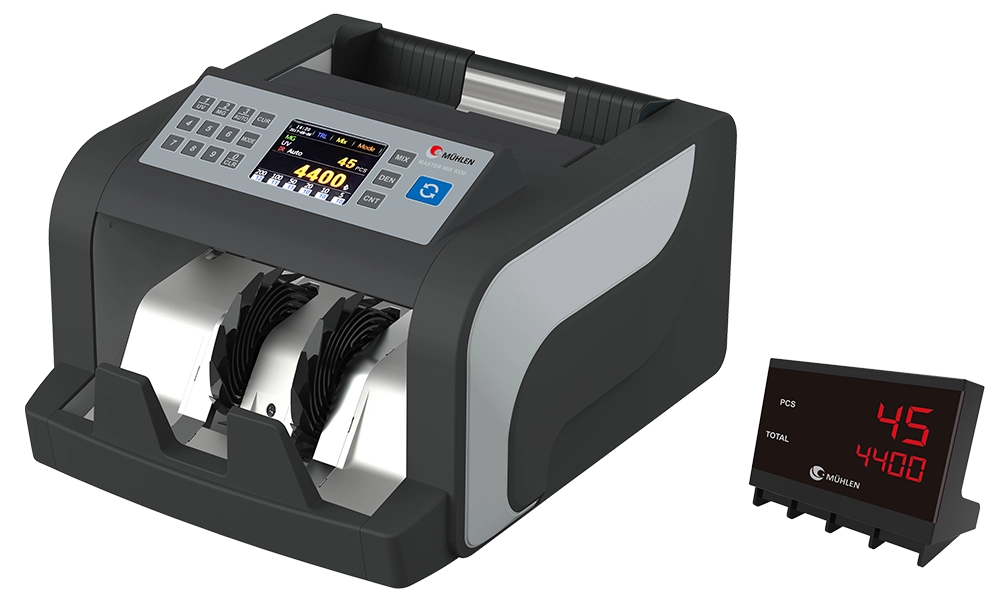
For businesses that say "buying makes sense but I do not want to strain the budget", starting with an entry-level model is the most balanced route. The Mühlen Raptor A17 economical money counting machine with spoken prompts is positioned for exactly this need: it announces count results with spoken notifications, its compact build fits on the till counter and it is the brand's most popular money counting model. It is ideal as a first device for supermarkets, restaurants, pharmacies and stores doing a daily till count.
As cash volume grows the need develops too; the Raptor family offers graduated options for that climb:
| Model | Who is it for? | Standout feature | Price |
|---|---|---|---|
| Raptor A17 | Businesses doing a daily till count | Spoken notifications, economical entry model | Request a quote |
| Raptor A27 | Those looking for more comfortable operation | Touch screen | Request a quote |
| Raptor B37 | Busy tills working with mixed bundles | Mixed banknote counting with a CIS sensor | Request a quote |
Note: you can learn current prices and stock for all the models in the table by requesting a quote over WhatsApp.
Decision Guide: The Right Choice in Three Questions
To simplify your decision, follow this flow:
- Do you need the device for less than a month? If yes, renting or buying it as a service can be considered. If no, move to the second question.
- Is cash counting part of your weekly routine? If yes, buying is clearly more economical; rental payments reach the device price in a short time.
- Is it the budget pushing you towards renting? Then go not for a large device but for an entry-level model such as the Raptor A17; you can move up when the need grows.
You can also look at our guide on how to choose a money counting machine, where we explain in detail how to assess speed, capacity and counterfeit detection features.
Conclusion: Let Us Clarify Your Decision and Prepare Your Quote
To sum up: renting is defensible for a temporary need of a few days; but for every business counting cash regularly, buying is the more sensible investment in terms of both total cost and the assurance of warranty and service. Send us your business's daily banknote volume; let us determine the most suitable model together and prepare your current quote. You can reach us immediately on our WhatsApp line or write to us from our contact page.
Frequently Asked Questions
Can a money counting machine be rented?
Yes, a limited number of firms offer money counting machine rental for events and seasonal needs. But the options are narrow, the devices are usually used and the warranty does not belong to you. If use will exceed a few weeks, the total rental fee quickly approaches the purchase cost.
Which businesses does renting make sense for?
It makes sense for teams running box-office or cash counting at organisations lasting a few days, such as trade fairs, festivals and charity sales, and for businesses with a one-off intensive counting period. If cash counting recurs regularly, buying is more economical in every scenario.
How many years does a purchased money counting machine last?
A quality device that is maintained regularly works without trouble for years. Simple routines such as cleaning the sensors and servicing the rollers extend its life; because continuity of spare parts and service also carries on under distributor assurance, the device keeps its asset value for many years.
Does the same decision apply to coins?
The logic is the same: if the volume of coins is continuous (a supermarket, bakery or vending operation, for example), investing in a device is more economical than renting. For this need you can review the counting and sorting models in the coin counting machines category.
Will an entry-level model be enough for my business?
For most SMEs doing a daily till count, yes. An economical model such as the Raptor A17 meets the need for bundle counting and counterfeit detection. If daily turnover is very high or mixed-bundle counting is required, upper models with a CIS sensor should be assessed; send us your banknote volume and we can determine the right model together.