

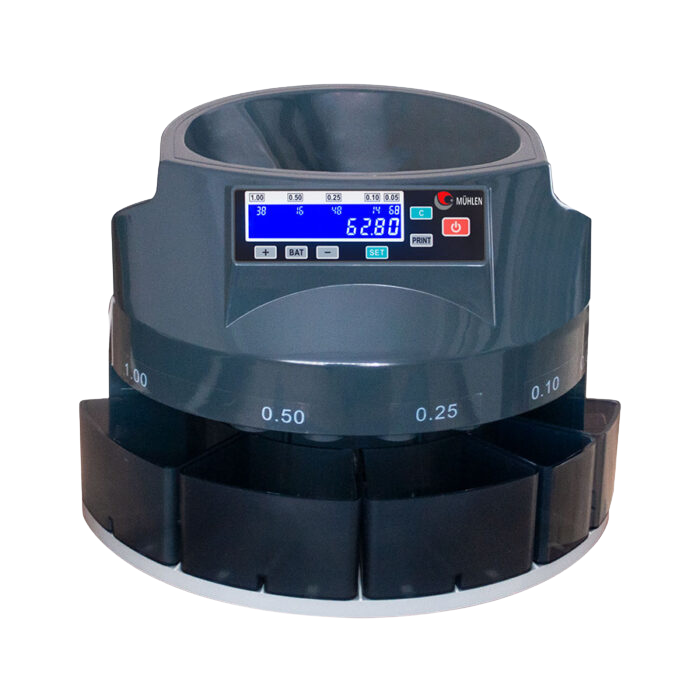
A coin counting machine is a device that passes coins through its hopper and calculates their number and total value in seconds. Models with a sorting feature also group the coins into separate compartments by denomination. For supermarkets, bakeries, vending operators and ticket booths that accumulate heavy volumes of coins every day, it is a far faster and error-free solution compared with counting by hand.
Counting a handful of coins from the till at the end of the day takes a few minutes; but when the job turns into bucketfuls of coins the picture changes. In this guide we explain step by step how a coin counting machine works, the difference between counting and sorting, which businesses really need such a device and how to choose the right capacity.
What Is a Coin Counting Machine and How Does It Differ From a Banknote Counter?
A coin counting machine is a device designed to count metal coins only. Its working principle is completely different from machines that count paper money:
- Feeding method: in a banknote counter the notes are placed as a neat bundle. In a coin machine the coins are poured in mixed into a wide hopper; the machine lines them up into a single row itself.
- Recognition technology: paper money machines read the security features of a banknote with UV, MG and IR sensors. Coin machines recognise each denomination by its diameter and thickness.
- Additional function: on the banknote side counterfeit detection comes to the fore, while on the coin side the standout feature is sorting: grouping coins into separate compartments by denomination.
So the two devices are not alternatives to each other but complements. If both banknotes and coins are heavy in your till, see the money counting machines category for paper money and the rest of this guide for coins.
How Do Counting and Sorting Work?
Coin counting takes place in three stages: the mixed coins poured into the hopper are lined up in a single row by a rotating disc, a sensor recognises each coin by its diameter as it passes through a channel, and the counter writes both the number and the amount on the display. Counting that takes minutes by hand comes down to seconds.
Models that only count
Entry-level devices count all the coins and collect them in a single hopper. This is enough for businesses that want to know the total amount but have no need to separate the coins by denomination.
Models that count and sort
This is the feature that really saves time. A sorting model such as the Mühlen Münzen coin counting and sorting machine groups every denomination from 1 kuruş up to 1 lira into its own compartment while counting the mixed coins. That way you both see the total amount and have the coins separated ready for wrapping, for the till or for the bank.
For businesses that have to keep records there is a further step: the Mühlen Münzen 3 can be connected to a printer, so you can take the end-of-day count result as a receipt and add it to the till report.
Who Needs a Coin Counting Machine?
The rule is simple: if more coins accumulate by the end of the day than you can count by hand, the machine pays for itself in labour. Typical scenarios:
Supermarkets, corner shops and delicatessens
Coins pile up in the till anywhere small-value, high-frequency cash trade takes place. Counting coins at closing, which takes a cashier 20–30 minutes, comes down to a few minutes with a machine; arguments about till shortages and surpluses end too.
Bakeries and patisseries
Bakeries are among the businesses where coins circulate most heavily. In a bakery constantly taking coins and giving change during the morning rush, a sorting model brings great comfort both for the end-of-day count and for preparing change for the next day.
Vending and amusement arcade operators
Self-service coffee machines, gaming machines, token systems and self-service wash bays… In these businesses turnover is collected almost entirely in coins. Counting by hand the load of coins that arrives in buckets on the weekly collection round is effectively impossible; a fast model with a high hopper capacity is a necessity here.
Municipal and transport ticket booths
At points such as car park booths, public bakery kiosks, transport and bridge tolls, the end-of-day accounting has to be both fast and documentable. Models with a printer connection are particularly preferred on the public and corporate side because they produce a receipt that can be attached to the record at shift handover.
A Practical Answer to "Where Can I Cash In My Coins?"
Most people asking this are looking for a way to turn accumulated coins into usable money. Publicly accessible coin-exchange kiosks at supermarket entrances, as found in some countries, are not widespread in Türkiye; the destination for accumulated coins is a bank branch. In practice, however, branches prefer to receive large quantities of coins already counted and grouped by denomination; a bag of mixed coins makes the transaction drag on.
If your business accumulates coins regularly, the most practical route is to count and sort them on your own counter and go to the bank with ready groups. For those who want to go a step further, the Mühlen Fişek H16 coin wrapping machine turns the separated coins into rolls; this format is accepted as standard both for bank deposits and for cash transfers between branches.
How to Choose Capacity and Speed
The question that determines the right model is this: how many change transactions do you handle a day, and how many coins accumulate by the end of it? Four criteria are decisive:
- Hopper capacity: the amount of coins you can pour in at once. Emptying a bucket into a small-hopper device in five goes eats up the speed advantage.
- Counting speed: the number of coins counted per minute. Entry level is enough for a business whose daily volume does not exceed a small cup; the vending operator counting bucketfuls needs a high-speed model such as the Mühlen Jet 5 fast coin counting machine.
- Sorting compartments: the Turkish lira coin series consists of six denominations — 1, 5, 10, 25 and 50 kuruş and 1 lira. If you will prepare coins grouped for the bank or the till, choose a model that separates every denomination.
- Reporting: if shift handover and accounting records are required, go for a model with a printer connection.
Featured Mühlen Coin Counting Models
The table below compares the models that stand out for different requirement profiles. All models are compatible with the Turkish lira coin series:
| Model | Counting | Sorting | Standout feature | Price |
|---|---|---|---|---|
| Mühlen Münzen | Yes | Yes | Counting + grouping by denomination together; the most popular balanced model | Request a quote |
| Mühlen Münzen 3 | Yes | Yes | Connects to a printer; receipt output for shift/till reports | Request a quote |
| Mühlen Jet 5 | Yes | Yes | High counting speed; for high-volume businesses such as vending and ticket booths | Request a quote |
| Mühlen Fhole | Yes | Yes | Compact counting-and-sorting solution; counter-top use | Request a quote |
| Mühlen Fişek H16 | — | — | Turns counted coins into rolls; prepares them for bank deposit | Request a quote |
You can review all models and current stock in the coin counting machines category.
Frequently Asked Questions
Which coins does a coin counting machine count?
Models sold in Türkiye count the entire Turkish lira coin series (1, 5, 10, 25 and 50 kuruş and 1 lira), recognising each by diameter and thickness. Coins poured in mixed are separated by denomination automatically by the machine.
What is the difference between counting and sorting?
Counting means calculating the number of coins and the total amount; all the coins are collected in a single hopper. Sorting means grouping each denomination into its own compartment during the count. For businesses making bank deposits or preparing change, a sorting model is markedly more practical.
What does the machine do with foreign or damaged coins?
Because the device recognises every coin by diameter and thickness, foreign coins and tokens whose dimensions do not match the Turkish lira series are not included in the count. Severely deformed coins may not travel along the channel; in that case they have to be removed from the hopper and sorted out by hand.
Is a machine essential for depositing coins at the bank?
It is not essential, but branches prefer to receive large quantities of coins counted and grouped. In businesses that deposit coins regularly, a sorting machine and, where needed, a wrapping device speed the bank process up considerably.
How many coins make buying a machine sensible?
There is no clear threshold; the practical measure is time. If the end-of-day coin count takes more than 15–20 minutes of a member of staff's time, or if counting errors create till discrepancies, the investment pays for itself quickly. If you share your daily volume with us, we can determine the right capacity for you together.
Conclusion: Let Us Choose the Right Model Together
Choosing a coin counting machine depends on your daily coin volume, your need for sorting and your reporting expectations. The balanced Münzen stands out for supermarkets and bakeries, the Jet 5 for high-volume vending operators, and the printer-connected Münzen 3 for booths that need documented handovers.
If you are not sure which model suits your business, you do not have to decide alone: write to us on our WhatsApp line with your daily coin volume and let us choose the right model together. To see the products in person or get detailed information, you can reach us from our contact page and request a quote quickly for any model.